Choosing a reliable Centre Bearing Assembly supplier requires more than comparing prices or browsing polished catalogues. This component supports the propeller shaft, manages rotational movement, and helps control vibration beneath the vehicle. A weak bearing can create humming sounds, floor tremors, uneven wear, or costly driveline damage.
Dr. John R. Fancher, a respected vehicle dynamics researcher, once stated, “Reliable driveline performance depends on controlling vibration, alignment, and load together.” That principle guides this supplier review. Each company is examined through practical indicators, including manufacturing experience, material consistency, bearing design, rubber support quality, testing procedures, and aftermarket availability. Factory certifications matter. So do traceable specifications and responsive technical support.
The top ten list is not a perfect ranking. Supplier strengths can change by vehicle type, region, and production batch. That deserves attention. A manufacturer serving heavy trucks may not suit a passenger-car driveshaft. Likewise, a low-cost assembly may appear attractive until installation reveals poor fitment or excessive noise.
This introduction provides a realistic starting point for buyers, distributors, repair specialists, and vehicle manufacturers. It considers established global brands and capable regional producers. The review also recognizes an uncomfortable fact: public supplier information is sometimes incomplete. Therefore, readers should verify current certifications, dimensions, warranty terms, and testing records before purchasing. A dependable Centre Bearing Assembly should fit accurately, operate quietly, and remain stable under heat, load, and continuous road vibration.
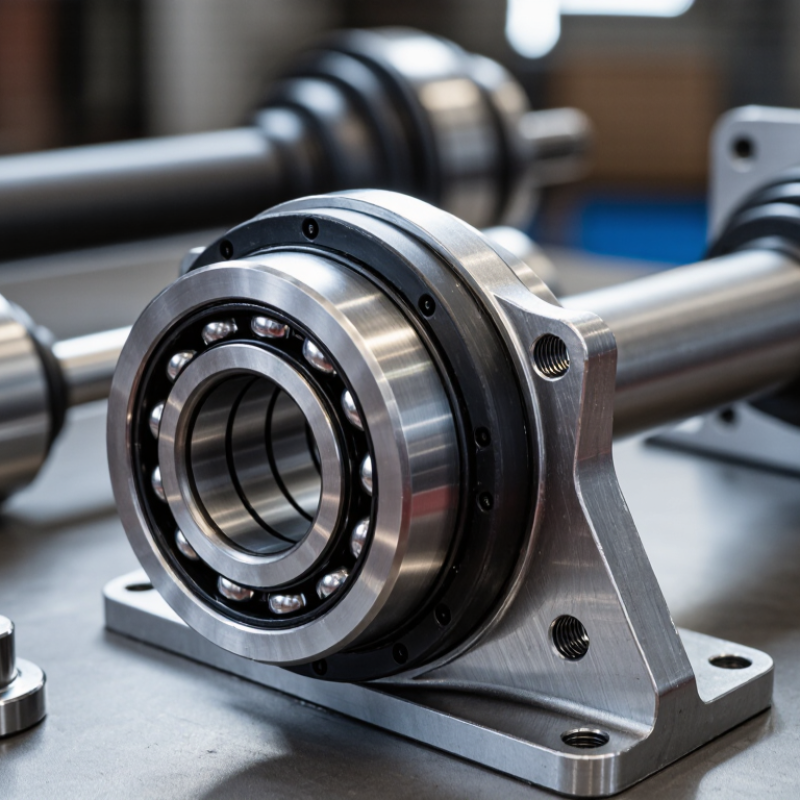
A centre bearing assembly supports the middle section of a vehicle’s propeller shaft. It usually combines a bearing, rubber insulator, mounting bracket, and protective seal. The assembly keeps the shaft aligned while allowing controlled movement during driving.
It reduces vibration.
Without this support, a long propeller shaft can sag, wobble, or produce a low-frequency hum. The bearing also helps manage torque changes when a vehicle accelerates, brakes, or travels over uneven roads. In practical inspections, technicians often check rubber cracks, unusual play, grease leakage, and heat marks around the bearing housing. These small signs may reveal a larger driveline problem.
China’s automotive scale makes this component strategically important. The China Association of Automobile Manufacturers reported 30.16 million vehicle units produced in 2023. New-energy vehicle production reached about 9.59 million units, representing 31.6% of total vehicle production. These figures support strong demand for reliable driveline and chassis components, including centre bearing assemblies. However, production volume does not automatically prove supplier quality. A top-ten supplier list should consider dimensional consistency, fatigue testing, sealing performance, traceable materials, and delivery stability. ISO-based quality systems are useful evidence, but they are not the whole answer. I would also examine real failure data and cold-weather test results. Supplier rankings can look precise, yet field conditions remain unpredictable. That is the part many purchasing reviews understate.
Ranking China’s top ten centre bearing assembly suppliers requires more than comparing catalogues or quoted prices. Our criteria begin with engineering capability: load calculations, shaft fit, vibration control, sealing design, and material selection. We examine whether drawings match production parts, not just polished website claims. Factory visits, sample inspections, and discussions with quality engineers provide practical evidence. This matters.
Quality consistency receives the heaviest weighting. We review incoming-material controls, heat-treatment records, dimensional reports, endurance testing, and final inspection procedures. Suppliers should provide batch traceability from steel receipt to packed assembly. We also assess equipment condition, calibration intervals, operator training, and corrective-action records. A strong supplier can explain a failed test without hiding it. That honesty counts.
Delivery reliability, export experience, technical support, and realistic production capacity shape the remaining scores. We compare lead times against actual shipment records and test communication during specification changes. Flexible customization earns credit, but unverified promises do not. Pricing matters, yet unusually low offers may signal thinner materials or weaker controls. Our ranking is not flawless; factory conditions and documentation can change. Rechecking data each year is necessary, even when the previous score looked convincing.
The following anonymized ranking uses a weighted evaluation model for Chinese centre bearing assembly manufacturers. The assessment focuses on measurable procurement factors, including quality systems, automotive-process capability, product coverage, testing, customization, production capacity, export readiness, and after-sales support.
| Rank | Anonymous Supplier Profile | Quality & Automotive Certifications | Product and Vehicle Coverage | Testing and Validation Capability | Customization & Engineering Support | Manufacturing & Supply Capability | Export Readiness | Weighted Score | Overall Assessment |
|---|---|---|---|---|---|---|---|---|---|
| 1 | Profile A | ISO 9001; automotive-process controls aligned with IATF 16949 practices; PPAP and traceability available | Passenger vehicles, light commercial vehicles, and selected heavy-duty applications | Dimensional inspection, hardness testing, rubber-property checks, bearing noise inspection, and endurance validation | Drawing review, sample approval, material alternatives, and packaging customization | Integrated machining, rubber molding, bearing assembly, final inspection, and batch traceability | Export documentation, multilingual technical files, and experience with distributor and OEM-style orders | 91/100 | Excellent |
| 2 | Profile B | ISO 9001; documented incoming, in-process, and final quality controls | Broad passenger-car and light-truck replacement coverage | Runout, concentricity, bearing clearance, vibration, and visual-defect inspection | Part-number matching, sample development, and private-label packaging support | Stable medium-to-large batch production with automated pressing and inspection stations | Regular export shipments and standard commercial documentation | 88/100 | Excellent |
| 3 | Profile C | ISO 9001; supplier qualification and lot-level inspection procedures | Passenger cars, vans, pickups, and selected commercial vehicles | Material verification, bearing rotation testing, dimensional measurement, and rubber aging checks | Technical drawing confirmation and low-volume sample support | Flexible production lines suitable for mixed part-number orders | Strong aftermarket export capability and standard export packaging | 85/100 | Very Good |
| 4 | Profile D | ISO 9001; documented corrective-action and nonconformance procedures | Common passenger-car and light-commercial applications | Dimensional reports, visual inspection, bearing smoothness checks, and basic durability testing | Standardized replacement designs and packaging customization | Consistent production for recurring aftermarket programs | Established shipping processes for international distributors | 82/100 | Very Good |
| 5 | Profile E | ISO 9001 or equivalent quality-management documentation; incoming material controls | High-volume coverage for mainstream passenger vehicles | Routine dimensional, visual, bearing rotation, and rubber-bonding inspections | Catalog-based technical support with limited engineering modification | Competitive batch production and standardized assembly processes | Suitable for container and consolidated export orders | 79/100 | Good |
| 6 | Profile F | ISO 9001; basic process records and supplier-management controls | Passenger vehicles and selected light commercial applications | Dimensional inspection, visual checks, bearing noise screening, and sample validation | Part-number cross-reference and limited sample customization | Moderate production capacity with flexible order scheduling | Export support available for standard products | 76/100 | Good |
| 7 | Profile G | Quality system documented; certification scope should be confirmed before contracting | Selected passenger-car, van, and pickup applications | Basic dimensional and visual inspection with sample-based functional checks | Suitable for standard drawings and aftermarket packaging | Small-to-medium batch capability with competitive lead times for catalog items | Works mainly through trading and distribution channels | 73/100 | Good |
| 8 | Profile H | Basic quality-management procedures; formal automotive certification may vary by facility | Narrower coverage focused on common replacement applications | Routine visual, dimensional, and bearing-rotation inspection | Limited engineering support; primarily catalog and drawing-based supply | Suitable for small and medium aftermarket orders | Export capability available with buyer-defined documentation requirements | 70/100 | Acceptable |
| 9 | Profile I | Documented inspection procedures; certification and audit evidence require buyer verification | Limited vehicle coverage with emphasis on price-sensitive applications | Basic dimensional, visual, and packaging inspection | Low customization capability and longer sample-development cycles | Best suited to planned batch orders rather than urgent mixed orders | International shipment support available for selected markets | 67/100 | Acceptable |
| 10 | Profile J | Basic factory quality controls; third-party audit and certification status should be checked | Small catalog concentrated on common centre bearing assemblies | Standard visual and dimensional inspection; advanced validation may be outsourced | Limited customization and engineering resources | Small-batch production with capacity subject to order mix | Suitable for trial orders after packaging, labeling, and documentation review | 64/100 | Conditional |
China’s top ten centre bearing assembly suppliers serve truck, bus, agricultural, and industrial driveline markets. Their strengths differ, so buyers should compare evidence rather than rely on rankings.
Details matter.
Ask for material certificates, hardness records, and dynamic balancing results.
Request samples from the intended production batch.
A clean inspection report helps, but it does not replace physical testing.
I would also check sealing after dust and water exposure.
That step is often overlooked.
Supplier experience becomes clearer through failure analysis.
Can the engineering team explain premature wear, cracking, or abnormal noise?
Do they keep corrective-action records?
Some factories advertise broad capabilities but outsource critical processes.
That is not automatically a weakness, yet it requires disclosure.
Delivery performance can also change during peak seasons.
A careful buyer should review recent lead times, not old promises.
Mistakes happen, even in capable plants.
Reliable cooperation depends on how openly suppliers address them.
Evaluating China’s top ten centre bearing assembly suppliers requires more than comparing catalogue prices. In workshop audits, I examine bearing fit, rubber hardness, metal thickness, and grease retention. A reliable assembly should rotate smoothly without axial looseness. Small deviations often become vibration at highway speed. Product comparison should include standard and heavy-duty variants, spline compatibility, mounting-hole accuracy, and operating temperature ranges. Ask for dimensional drawings, material certificates, and endurance-test records. Some suppliers explain these details well. Others provide attractive samples but limited data.
Quality depends on repeatability, not one perfect sample. Check incoming inspection, CNC or stamping controls, vulcanization records, and final runout testing. Traceable batch codes make complaints easier to investigate. I also look for calibrated gauges and documented corrective actions. ISO-based procedures help, but certification alone cannot prove field performance. A few factories still rely heavily on manual checks. That can work, yet operator fatigue creates uneven results. This weakness deserves honest discussion.
Manufacturing capability includes tooling, production capacity, engineering support, and export packaging. Suppliers with in-house molds can revise rubber geometry faster. Automated pressing and balancing equipment usually improve consistency. However, automation is not a guarantee. Poor process settings can repeat defects at scale. Request pilot batches before long-term orders, then compare noise, hardness, and bearing play after testing. Lead time also matters. A capable supplier should explain capacity during peak seasons and provide realistic replacement plans when specifications change.
Comparison of anonymized supplier capability profiles based on product coverage, quality systems, manufacturing capacity, engineering support, and export readiness. Scores are normalized on a 0–100 benchmark scale and are intended for preliminary supplier screening.
Higher scores indicate stronger overall capability across centre bearing assembly production, quality control, customization, and international supply support. Final supplier selection should verify certifications, samples, audit results, and delivery records.
Selecting the right centre bearing assembly supplier requires more than comparing prices. China’s automobile production reached 30.16 million units in 2023, according to the China Association of Automobile Manufacturers. This scale creates strong manufacturing capacity, but quality still varies between suppliers. The top 10 list should be a starting point, not a final decision.
Check whether each supplier can provide material certificates, heat-treatment records, dimensional reports, and traceable batch numbers. Ask for dynamic load testing, vibration testing, and rubber durability results. Grand View Research projects continued growth in the global automotive bearings market, driven by vehicle production and replacement demand. A capable supplier should support both original-equipment requirements and aftermarket conditions. Request samples from different production batches. One perfect sample proves little.
Tips: Compare suppliers using a written scorecard. Give quality 30%, testing 20%, delivery performance 20%, engineering support 15%, and price 15%. Confirm ISO 9001 certification, but do not treat certification as proof of product reliability. Visit the factory if possible. Look closely at bearing grease, seal edges, casting surfaces, and packaging moisture. Ask for corrective-action records from previous failures. Cheap quotations can hide weaker steel, inconsistent balancing, or short warranty terms. I would also verify communication speed; delayed technical replies often predict trouble after mass production begins. Some evaluation methods remain imperfect, especially when suppliers provide incomplete field data. That uncertainty deserves attention.
Compare engineering ability, quality consistency, delivery reliability, technical support, and production capacity. Evidence matters most. Factory visits and sample inspections reveal more than catalogue claims. Quoted price should not decide the ranking alone.
Request material certificates, hardness records, heat-treatment results, dimensional reports, and endurance-test records. Ask for batch traceability from steel receipt to packed assembly. Calibrated gauges and corrective-action records also matter.
Request samples from the intended production batch. Compare drawings with measured bearing fit, rubber hardness, metal thickness, and mounting-hole accuracy. One excellent sample proves little. Repeatability matters more.
Check smooth rotation, axial looseness, runout, vibration, grease retention, and sealing performance. Expose samples to dust and water. Test noise and hardness after endurance cycles. Test it physically.
Incorrect rubber hardness can increase vibration during highway driving. Weak sealing may allow dust or water into the bearing area. Review vulcanization records and operating temperature ranges. This step is often overlooked.
No. Automated pressing, balancing, and measurement can improve consistency, but poor settings repeat defects quickly. Ask about equipment calibration and process monitoring. Manual checks may work, though operator fatigue can create uneven results.
Compare promised lead times with recent shipment records, especially during peak seasons. Ask how the factory handles specification changes or capacity shortages. Old promises may mislead. Recent evidence is safer.
Ask whether engineers can explain premature wear, cracking, abnormal noise, or failed tests. Review corrective-action records and replacement plans. A capable supplier may still make mistakes. Honesty counts more than polished claims.
Price matters, but unusually low offers may indicate thinner materials or weaker controls. Compare total evidence, including testing, packaging, lead time, and traceability. The cheapest option is not always economical. I may still miss hidden costs.
Factory conditions, equipment, staffing, capacity, and documentation can change. Recheck quality records, shipment performance, and sample results each year. A previous score may no longer fit. Rankings are imperfect.
This article presents a practical overview of the China Top 10 Centre Bearing Assembly suppliers, beginning with the function and importance of this component in vehicle driveline systems. A Centre Bearing Assembly supports the propeller shaft, helps maintain alignment, reduces vibration, and contributes to smoother and safer power transmission. The ranking approach focuses on factors such as product consistency, engineering capability, manufacturing capacity, material selection, quality control, certifications, delivery reliability, and customer support.
The supplier profiles then compare their typical product ranges, customization abilities, production processes, testing standards, and service strengths without focusing on brand promotion. Readers will also find guidance on evaluating bearing design, rubber and metal quality, load performance, durability, pricing, lead times, and after-sales communication. By considering both technical requirements and long-term cooperation potential, buyers can identify a dependable Centre Bearing Assembly supplier that matches their vehicle application, purchasing volume, quality expectations, and budget.