In heavy-duty commercial transport, commercial exhaust silencer mounting rubber (commonly specified as exhaust hanger bushes, muffler isolator blocks, and tailpipe damping brackets) operates at the violent convergence of mechanical vibration, harsh environmental exposure, and extreme thermal cycling. Designed to isolate exhaust harmonic frequencies while withstanding static weight loads across rough terrain, selecting the correct elastomeric formulation dictates long-term fleet uptime. Since 1980, Amit Rubber Products has delivered OEM and replacement exhaust rubber components engineered to prevent exhaust pipe fracture, reduce cab noise, and withstand corrosive road salts and oils.
Commercial vehicle exhaust lines experience thermal growth, severe angular displacement, and sustained resonant excitation. Our mounting blocks and hanger rings are formulated to arrest mechanical fatigue while resisting ambient petroleum splashes and chassis dirt wash.
Exhaust systems expand substantially in length between cold idle and full turbo boost. Our mounting rubber compounds undergo vulcanization under strictly managed cure profiles to maintain exceptional tensile recovery and hysteresis loss across thousands of operating hours.
Elastomer BaseHigh-density EPDM (Ethylene Propylene Diene Monomer), Synthetic Blends, or Heavy-Duty Cast PU
Durometer Index60 to 70 Shore A (±5) for optimal harmonic absorption without excessive sag
Thermal ThresholdContinuous operation: -40°C to +135°C; Intermittent excursions up to +155°C
Tensile & ElongationTensile strength ≥ 14 MPa; Elongation at break ≥ 380% with minimal permanent creep
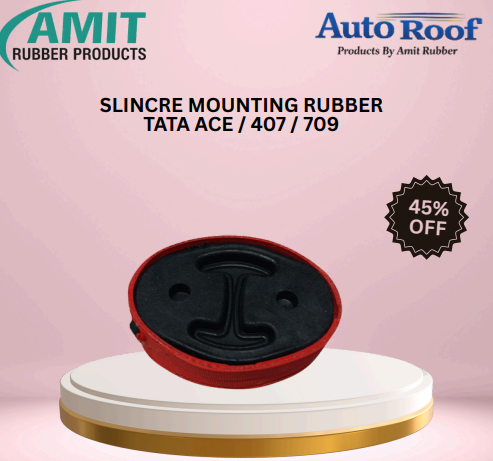
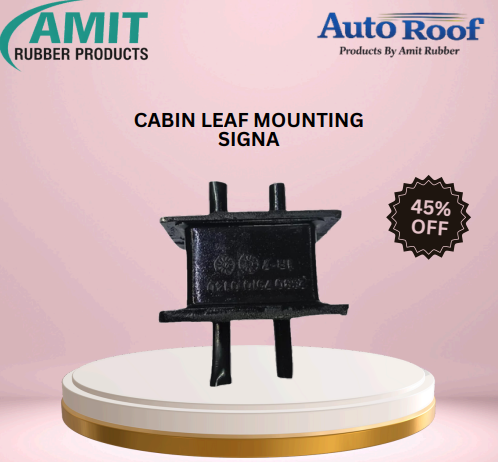
OE Cross ReferenceStandard fitments for Tata Ace, 407, 709, 1613, Signa; Ashok Leyland U-Truck, buses, and trailers
Engineers and international procurement heads must evaluate trade-offs between static load capacity, heat rejection, and dynamic spring rates when specifying exhaust bracket insulators.
Future Procurement Dynamics in Heavy-Duty Exhaust Suspension
Global supply chain volatility, rigorous emissions legislation, and total cost of ownership (TCO) benchmarks are transforming how Tier-1 wholesalers and fleet distributors procure exhaust hardware.
BS-VI / Euro-VI Thermal Surge
Modern exhaust aftertreatment systems—incorporating Diesel Particulate Filters (DPF) and Selective Catalytic Reduction (SCR) units—reach internal temperatures exceeding 600°C during active regeneration. Radiant heat reaching external hanger brackets routinely tops 140°C, rendering conventional natural rubber obsolete. Global buyers are mandating peroxide-vulcanized EPDM and fluoroelastomer-reinforced hanger compositions to safeguard against thermal embrittlement.
Fleet operators are shifting purchasing paradigms from unit acquisition cost to Mean Time Between Failures (MTBF). A ruptured $3 exhaust mounting rubber can precipitate cracked exhaust manifolds, broken turbo outlet joints, and roadside regulatory penalties exceeding $2,000. Purchasing directors increasingly specify dual-elastomer compounds that retain tensile modulus across 250,000+ kilometers of severe axle oscillation.
Procurement entities in North America, Western Europe, and the Middle East are divesting from trading intermediaries in favor of direct Indian manufacturing facilities. Direct factory integration offers full audit trails on compound formulations, raw polymer verification, zero distributor markups, and rapid custom tooling execution for legacy or proprietary vehicle platforms.
Export compliance demands strict alignment with European REACH and RoHS standards, outlawing harmful plasticizers, heavy-metal accelerators, and polycyclic aromatic hydrocarbons (PAHs). Forward-looking manufacturers implement eco-formulations that achieve zero toxic off-gassing while enhancing resistance to road de-icing chlorides and chemical chassis degreasers.
Technological Evolution of Exhaust Silencer Suspension Systems
From simplistic punched rubber strips to FEA-modeled elastomeric dampeners, exhaust suspension engineering continues to advance along three critical vectors.
The earliest exhaust mounting designs relied on basic punched natural rubber sheet remnants reinforced with cotton fabric. In modern commercial trucking environments, the introduction of high-torque common-rail turbodiesel engines and rigid Euro-VI exhaust stacks has completely outgrown legacy solutions.
Today, finite element analysis (FEA) is routinely utilized by Amit Rubber Products to model internal shear stresses, stress concentrations around bracket holes, and directional displacement envelopes. By engineering varied wall thicknesses and stress-relieving teardrop contours into the vulcanization mold, localized stress concentrations are dispersed uniformly across the elastomer body.
Furthermore, hybrid bonding architectures—where zinc-plated, passivated steel brackets are chemically vulcanized directly to high-temperature elastomers—are steadily supplanting slip-on isolator rings. These bonded silencer supports eliminate metal-on-metal bracket fretting, eliminate squeaks, and ensure the exhaust cannister maintains correct clearance with fuel tanks, pneumatic brake lines, and chassis frame rails.
FEA-optimized teardrop stress dispersion profiles
Direct rubber-to-metal vulcanization with Chemlok® adhesion
Non-linear dynamic spring characteristics for multi-axis load dampening
Automated flash trimming for zero structural notch propagation
Why Global Importers Partner with Amit Rubber Products
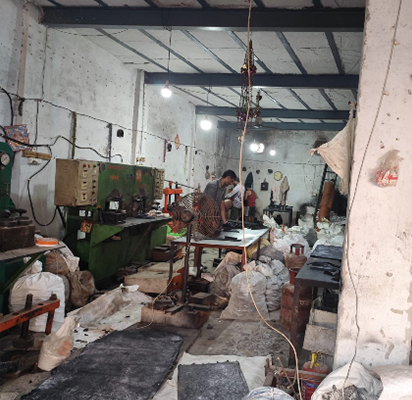
Established in 1980 in the historic automotive industrial hub of Kashmere Gate, New Delhi, Amit Rubber Products is an established Indian manufacturer and exporter specializing in heavy-duty automotive rubber and polyurethane systems.
Primary Manufacturer Advantage
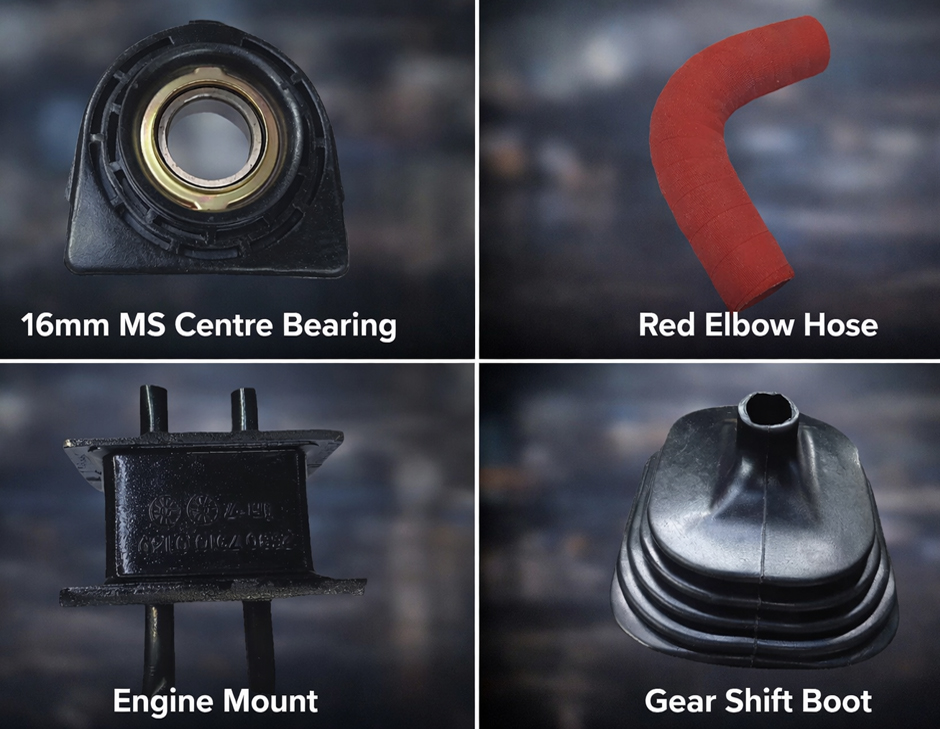
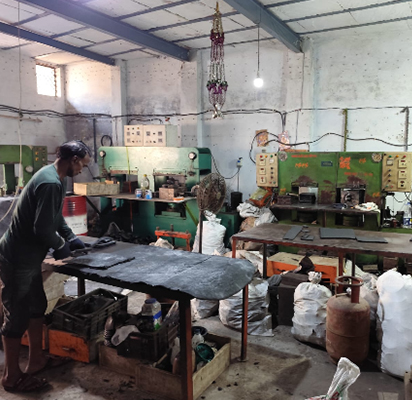
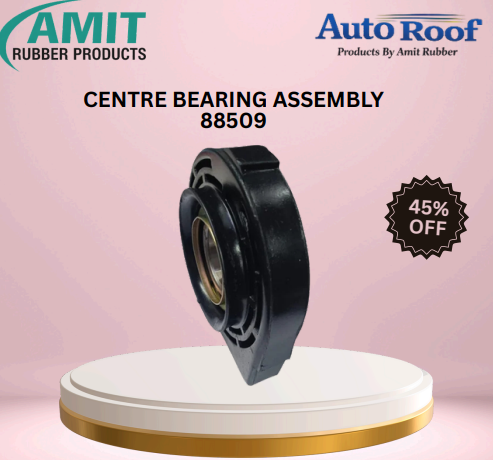
We are a dedicated manufacturing enterprise, not a commercial broker. Every batch of exhaust silencer mounting rubber, propeller shaft centre bearing, and engine mount is vulcanized and trimmed in-house under controlled cure parameters, eliminating intermediary markups and ensuring complete quality transparency.
In-House Tooling & Custom Moulding
Under the visionary technical leadership of Mr. Amit Chitkara, our tooling department crafts bespoke compression and transfer moulds from technical blueprints, 3D CAD files, or physical OE benchmark specimens, rapidly delivering custom prototypes with tailored durometer and compound choices.
Rigorous Pre-Dispatch Verification
Quality control operates as our core operational metric. Every lot undergoes strict pre-shipment inspections covering dimensional tolerances, durometer hardness calibration, rubber-to-metal bonding integrity, and surface defect elimination to ensure zero returns across international waters.
Since 1980 Excellence
More than four decades of dedicated polymer compounding for global commercial fleets.
20+ Export Destinations
Seamless international logistics covering Africa, Europe, Middle East, and Asia-Pacific.
Engineer-Led Support
Direct communication with production specialists who formulate the compounds and oversee the moulds.
Buyer's FAQ: Exhaust Silencer Mounting Rubber & Global Sourcing
Direct technical answers addressing the most critical questions global purchasing managers and engineers encounter during silencer component specification.
What causes premature failure in commercial exhaust silencer mounting rubber?
Premature elastomeric failure in heavy commercial vehicle silencers stems from four primary operational hazards: (1) Excessive Radiant Heat: Proximity to DPF, SCR, or catalytic converters degrades standard rubbers, causing embrittlement and surface micro-cracking; (2) Mechanical Shear Fatigue: Deep road ruts, washboard surfaces, and aggressive engine rocking exert multi-axial cyclic strain, resulting in tear propagation from mounting holes; (3) Hydrocarbon Degradation: Diesel leaks, axle lubricants, and chassis grease soften non-oil-resistant rubbers, causing internal bond delamination; and (4) Ozone & Atmospheric Oxidation: Inferior natural rubber compounds lacking antiozonant waxes suffer rapid dry-rot under intense sunlight and road salt exposure.
How do EPDM, silicone, and polyurethane exhaust hangers compare for heavy-duty applications?
Peroxide-cured EPDM represents the global commercial benchmark, offering an exceptional blend of low dynamic creep, broad temperature resistance (-40°C to +135°C), superior acoustic damping, and exceptional ozone resistance at an economical price point. Polyurethane offers higher tensile strength, outstanding abrasion resistance, and imperviousness to oils; however, PU possesses higher Shore A hardness, which can transmit unwanted chassis hum into the cab and may soften when exposed to high radiant temperatures over 95°C. Silicone elastomers excel in extreme heat (up to 200°C+) but present lower mechanical tear resistance, making them susceptible to notch shearing under rugged off-road axle movements.
What Shore A hardness is optimal for commercial truck exhaust silencer mounts?
For commercial trucks (such as Tata, Ashok Leyland, MAN, and Volvo platforms), an elastomeric hardness between 60 and 70 Shore A is recommended. A durometer below 55 Shore A permits excessive pipe oscillation, risking pipe contact with chassis crossmembers and inducing exhaust flange stress fractures. Conversely, compounds exceeding 75 Shore A become excessively rigid, transforming the isolator into a solid acoustic bridge that transmits droning exhaust resonance directly into the vehicle frame and cabin.
Can Amit Rubber Products manufacture custom exhaust silencer mounts from CAD drawings or OE samples?
Yes. Backed by 46+ years of specialized rubber and polyurethane manufacturing, our New Delhi production facility manages complete mold conception, tooling, compounding, and batch vulcanization. We regularly manufacture custom exhaust hanger rings, teardrop dampers, and vulcanized rubber-to-metal bracket assemblies directly from customer 2D/3D CAD blueprints, physical OE specimens, or specific vehicle platform reference codes.
What information is needed to get an accurate quotation and confirm fitment?
To provide an expedited commercial quotation and technical fitment verification, please share: (1) Vehicle make, model, chassis series, and year of manufacture; (2) OE part reference number or competitor code if available; (3) Dimensional parameters including overall height, width, thickness, hole inner diameter (ID), and center-to-center hole spacing; (4) Expected thermal environment (proximity to turbo or tailpipe); and (5) Projected procurement batch volume and delivery schedule.
What are your international export, packaging, and dispatch standards?
Serving distributors across more than 20 countries, we pack exhaust mounts in heavy-duty poly-lined inner bags packed within multi-wall corrugated master cartons, palletized on heat-treated fumigated pallets with protective shrink-wrap. We dispatch through premier international express parcel partners (DHL, FedEx) for urgent samples or fast-track shipments, and execute containerized LCL/FCL ocean freight from Nhava Sheva or Mundra ports for bulk commercial orders.
From cross-country freight lines to high-vibration agricultural equipment, our vibration-damping elastomer mounts are engineered for severe operating environments.
Long-Haul Freighters
Exhaust silencer mounts & centre bearings
Light Commercials
Hangers & mounts for Ace, 407 & Bolero
Utility & Municipal
Damping blocks for stop-and-go fleets
Agri-Tractors & Combines
Vibration dampers for high-shock engines
Passenger Coaches & Trailers
Acoustic isolation for quiet passenger cabs
Engineering Knowledge Base
Exhaust System Maintenance & Troubleshooting Guide
Practical diagnostic criteria and replacement protocols compiled by our technical engineering team for workshops, distributors, and fleet maintenance heads.
Exhaust System Clunk & Rattle
A metallic clunk when driving over speed bumps or sudden engine deceleration typically indicates that an exhaust silencer mounting rubber has snapped or elongated past its mechanical limit, allowing the steel pipe or muffler body to strike the vehicle chassis or axle housing.
Exhaust Manifold Stress Fractures
When flexible exhaust mounting rubbers degrade and freeze in a hardened, oxidized state, they no longer absorb engine torque twist. This rigid leverage force transfers directly upstream into the exhaust manifold and turbo downpipe, causing catastrophic metal fatigue and exhaust gas leaks.
Visual Warning Signs of Failure
Technicians should inspect silencer mounts during regular oil changes. Look for surface ozone cracking, elongated mounting pin holes (ovalization), rubber separation around molded metal inserts, or oil-softened, jelly-like rubber caused by drivetrain fluids.
Replacing in Complete Matched Sets
Never replace only a single failed exhaust hanger on a multi-point exhaust run. An isolated new mount will bear an unequal portion of the system weight, leading to premature shear failure within weeks. Always replace the entire run with matched-durometer units.
Proper Installation Clearance
During installation, ensure the exhaust hanger pins hang within the center of the rubber bracket without pre-tensioned lateral twisting. A pre-loaded or horizontally stretched rubber mount will rapidly fail due to continuous internal shear stress.
Recommended Spares Inventory
For fleet maintenance facilities and regional auto part distributors, maintaining an active buffer stock of high-turnover exhaust silencer rubbers (such as Tata 407/709, Leyland, and Bolero configurations) prevents costly roadside downtime and missed vehicle inspections.
What automotive distributors and fleet maintenance managers report about our parts and service reliability.
“We have been sourcing silencer mounting rubbers and engine mounts from Amit Rubber Products for our heavy truck fleet. Their rubber compounds withstand intense heat and harsh roads without premature cracking.”
RS
Rahul SharmaIndia
“Amit Rubber Products offers exceptional consistency. Their ability to deliver customized exhaust rubbers and polyurethane bushes according to our drawings has streamlined our regional distribution catalogue.”
AV
Amit VermaIndia
“Direct factory procurement with Mr. Amit Chitkara ensures our purchase orders are processed with technical accuracy. Their high-heat EPDM silencer mounts have significantly lowered our warranty claims.”
NS
Neha SinghIndia
“A reliable Indian manufacturer since 1980. Their silencer mounting rubbers for Tata and Leyland trucks match OE fitment and outlast generic aftermarket parts. Highly recommended supplier.”
VK
Vikas KumarIndia
Direct Factory Quotation & Technical Support
Connect directly with our engineering and export desk in New Delhi. Get fast pricing, sample validation, and custom mould feasibility assessments.
3Compound ProfilePreferred elastomer: EPDM, Natural Rubber, Silicone, or Polyurethane.
4Procurement VolumeTarget quantity, custom packaging specifications, and destination port.
OEM names, logos, and reference part numbers are utilized solely for cross-reference identification. Amit Rubber Products is an independent manufacturer of high-precision replacement rubber components.
 ( PU) 4018 T. C.png)
.png)