Welcome to Amit Rubber Products — Automotive Rubber Parts Manufacturer Since 1980 [email protected] +91-9871861285
0%

Why Choose a Turbocharger Rubber Hose Pipe?

A turbocharger works under demanding conditions. Hot compressed air moves through the system, while vibration shakes every connection. Oil mist may also enter the intake path. These conditions make hose quality more important than many drivers expect.

Dr. Alfred Büchi, widely recognized as the turbocharger’s inventor, expressed the core principle clearly: “Exhaust energy can increase engine power without increasing engine size.” His idea still shapes modern forced-induction systems. However, efficient turbocharging depends on more than the turbocharger itself. A reliable Turbocharger Rubber Hose Pipe must tolerate heat, pressure, flexing, and contact with oil vapor. Its reinforced rubber structure can help maintain airflow and reduce leakage around intercooler and intake connections.

Small details matter.

A properly selected hose should match the engine’s diameter, pressure range, temperature exposure, and routing space. A loose clamp can cause a boost leak. A badly routed pipe may rub against a bracket until the outer layer weakens. These failures often begin quietly, with reduced acceleration, hissing sounds, or unstable boost pressure.

Choosing a Turbocharger Rubber Hose Pipe is therefore a practical reliability decision, not merely a replacement task. Experienced technicians inspect the hose surface, inner lining, clamps, and nearby heat sources together. Still, no hose is perfect. Installation errors, excessive engine movement, or neglected maintenance can shorten its service life. The best choice combines verified material quality, correct fitment, and regular inspection under real operating conditions.
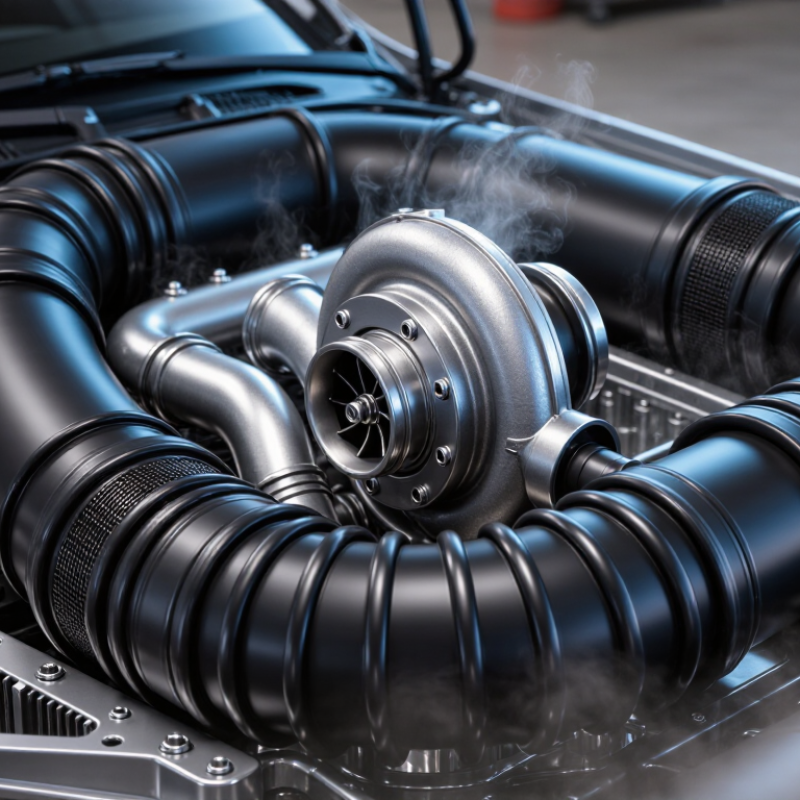
Why Choose a Turbocharger Rubber Hose Pipe?

Identify Turbocharger Hose Requirements: 180–200°C and 1.5–3.0 bar

Why Choose a Turbocharger Rubber Hose Pipe?

Turbocharger hose selection starts with measured conditions, not appearance. A hose exposed to 180–200°C needs a compound and reinforcement system rated above its continuous working temperature. SAE technical literature on downsized turbocharged engines records high compressor-outlet temperatures during sustained load. Short thermal peaks can exceed normal readings. Therefore, a 200°C rating may offer limited safety margin.

Pressure also matters. At 1.5–3.0 bar, the hose experiences internal stress, pulsation, and repeated expansion. Industry hose test practice, including ISO 16750 environmental testing principles, emphasizes pressure cycling, heat exposure, vibration, and fluid contact. A suitable turbocharger hose should resist oil mist, ozone, abrasion, and collapse under suction. Multi-layer silicone rubber with fabric reinforcement is commonly selected for these demands.

Check the real installation.

Measure the outside diameter carefully. A loose clamp can leak under boost, while excessive tightening can cut the rubber. Keep the bend radius generous, especially near the compressor outlet. In field inspections, softening often appears before visible cracking. That detail is easy to miss. I would also question any specification based only on peak pressure; temperature cycling and engine movement may cause earlier failure. SAE test reports frequently use repeated thermal and pressure cycles for this reason. A hose that survives one pressure test may still fail after months of heat, vibration, and oil exposure.

Compare EPDM and Silicone: 150°C vs 180–200°C Continuous Service

Why Choose a Turbocharger Rubber Hose Pipe?

A turbocharger rubber hose pipe must handle heat, pressure, vibration, and oil mist. EPDM is commonly suitable for continuous service near 150°C. It performs well in many intake and charge-air systems. It also offers good resistance to weather, coolant, and ozone. In a cooler engine bay, this can be a practical and economical choice. However, radiant heat from the turbine area may raise local temperatures unexpectedly.

Temperature labels can mislead.

Silicone hose generally supports continuous temperatures around 180–200°C. This higher range provides more safety when the pipe runs near exhaust components or has limited airflow. Silicone also stays flexible during repeated heating and cooling cycles. Yet, higher temperature resistance does not solve every problem. Silicone may resist some oils less effectively than EPDM. A thin oil film can soften unsuitable materials over time. Check chemical compatibility before installation.

In workshop inspections, I look for swelling, sticky surfaces, loose clamps, and fine cracks near bends. These small signs often appear before a visible failure. Measure the hottest section, not only the average engine temperature. A heat shield may reduce exposure, but it should not replace correct hose selection. I would not choose silicone automatically. If temperatures remain below 150°C, EPDM may be sufficient. If continuous heat approaches 180°C or more, silicone offers a more sensible margin. Hose thickness, reinforcement, routing, and clamp quality still matter. A perfect temperature rating cannot compensate for poor installation.

Use SAE J20 and ISO 1307 to Verify Hose Dimensions and Performance

Why Choose a Turbocharger Rubber Hose Pipe?

A turbocharger rubber hose pipe must handle heat, pressure, vibration, and repeated flexing. Standards help turn those demands into measurable checks. SAE J20 can guide hose construction and performance for suitable engine-fluid applications. However, it is mainly designed for coolant hoses. It should not automatically be treated as a complete charge-air specification. That distinction matters.

ISO 1307 helps verify nominal inside diameter, outside diameter, and dimensional tolerances. Use a calibrated vernier caliper at several points around the hose. Measure twice. A soft hose can flatten during measurement, creating misleading results. Compare the measured bore with the mating tube, then inspect the sealing area for uneven walls or cuts.

Performance testing should reflect real service conditions. Apply controlled pressure and temperature cycles, while checking expansion, leakage, surface cracking, and clamp movement. I have seen hoses pass a basic pressure test but fail after repeated heat exposure. The test method was too gentle. This is where professional judgment becomes important. SAE J20 and ISO 1307 provide useful reference points, but neither replaces application-specific validation. Check bend radius, reinforcement, material compatibility, and thermal aging before installation. Small dimensional errors can become large leaks under boost. A reliable inspection record should include measurements, test temperatures, pressure levels, and visible changes after cycling. That record supports traceability and exposes weak assumptions.

Evaluate Oil, Ozone, and Vibration Resistance for Long-Term Reliability

Why Choose a Turbocharger Rubber Hose Pipe?

A turbocharger hose works in a harsh, crowded space. Hot oil mist, ozone, pressure pulses, and engine vibration attack the rubber every day. In field inspections, small surface cracks often appear near clamps first. This detail matters.

Oil resistance should be verified, not assumed. ASTM D471 evaluates rubber volume and hardness changes after fluid exposure. A hose may swell, soften, or lose flexibility even when the outside looks clean. SAE J200 also helps engineers classify elastomers by oil, heat, and low-temperature performance. Test results must match the actual lubricant and temperature range. Generic oil testing is not enough.

Ozone damage is quieter. ISO 1431-1 commonly evaluates cracking under controlled ozone exposure, often near 50 pphm and 40°C. Test duration and strain vary by specification. Look for no visible cracking after the required exposure. Vibration needs equal attention. ISO 16750-3 recommends mechanical-load testing based on real vehicle conditions, rather than convenient laboratory assumptions. Secure clamps, smooth bends, and adequate wall thickness reduce fatigue concentration. Still, perfect test data cannot copy every engine bay. That is the uncomfortable part. Periodic inspection remains necessary. A reliable hose should resist oil, ozone, and vibration together, not only pass one attractive test.

Why Choose a Turbocharger Rubber Hose Pipe?

A balanced resistance profile helps turbocharger hoses withstand hot oil mist, ozone exposure, and continuous engine vibration over long service periods.

The chart uses a normalized engineering suitability score from 1 to 5, where 5 represents the strongest typical performance. NBR and HNBR generally provide strong oil resistance, while EPDM and silicone are highly resistant to ozone and weathering. FKM offers excellent resistance to oil and ozone, whereas vibration durability also depends on hose reinforcement, bend radius, clamp design, temperature, and installation conditions.

Scores represent typical elastomer characteristics used for comparative design screening and are not a substitute for application-specific hose testing.

Choose Reinforced Rubber Construction for Boost Stability and Safety

Why Choose a Turbocharger Rubber Hose Pipe?

Choose Reinforced Rubber Construction for Boost Stability and Safety

A turbocharger rubber hose pipe carries compressed air between the turbocharger, intercooler, and intake system. Reinforced rubber construction helps the hose resist pressure pulses, heat, vibration, and repeated engine movement. This support matters when boost pressure rises quickly under acceleration. A weak hose may expand, soften, or develop cracks around its bends.

In workshop inspections, I look closely at the inner wall, outer surface, and clamp areas. Small oil dampness can reveal a loose connection or early rubber degradation. Several reinforcement layers usually improve dimensional stability, helping the hose maintain a more consistent airflow path. The result can be steadier boost response and fewer sudden leaks during demanding driving.

Fit matters as much as material. A hose with the wrong diameter can create stress, even when its rubber feels strong. Keep it away from sharp edges and direct exhaust heat. Use suitable clamps, but avoid excessive tightening. It can damage the hose.

I once judged a hose by its clean appearance. That was a mistake. Surface condition alone cannot confirm internal strength. Regular inspection should include soft spots, bulges, oil saturation, and displaced clamps. No hose is indestructible. Choosing reinforced rubber improves safety margins, but correct installation and timely replacement remain essential.

Why Choose a Turbocharger Rubber Hose Pipe? - Choose Reinforced Rubber Construction for Boost Stability and Safety

Performance Dimension Typical Reference Data for Reinforced Rubber Turbo Hose Practical Benefit Selection or Inspection Point
Construction Elastomer tube with embedded textile reinforcement, commonly using two or more reinforcement layers for pressure-service applications. Improves dimensional stability and limits hose expansion when boost pressure rises. Confirm the reinforcement type, layer count, and construction are suitable for the vehicle’s pressure and temperature conditions.
Temperature Capability Many turbocharger rubber hose compounds are specified for approximately -40°C to +180°C, with short-duration limits often higher depending on the compound. Helps the hose withstand hot compressed air, engine-bay heat, and cold-start conditions. Use the manufacturer’s stated continuous and peak temperature ratings; do not size from ambient temperature alone.
Pressure Stability Working-pressure ratings vary by diameter and construction; reinforced boost hoses are commonly designed for several bar of positive pressure. Reduces ballooning, boost leakage, and changes in internal volume during acceleration. Choose a hose with a working-pressure rating above the system’s maximum boost, including pressure spikes.
Burst Safety Margin Quality pressure hoses are normally tested with a burst pressure substantially above their declared working pressure; the exact ratio depends on the applicable specification. Provides additional protection against sudden rupture caused by pressure peaks, aging, or installation stress. Review documented burst-test results and replace hoses showing cracks, swelling, cuts, or exposed reinforcement.
Oil-Mist Resistance Turbocharger charge-air systems may contain oil mist from crankcase ventilation or compressor-side carryover; oil-resistant rubber compounds are available for this service. Reduces softening, swelling, and loss of strength caused by prolonged exposure to oil vapor. Select a compound specifically rated for air, oil mist, and the expected service temperature.
Flexibility and Vibration Rubber remains flexible over a broad temperature range, while textile reinforcement helps control movement under pressure. Accommodates engine movement and helps reduce stress on intercooler, turbocharger, and intake connections. Avoid sharp bends, twisting, excessive stretching, and contact with moving or abrasive components.
Airflow and Internal Surface A correctly sized hose should maintain a smooth, unrestricted bore without kinks or internal collapse. Supports consistent charge-air flow and helps the turbocharger operate without avoidable restriction. Match the original internal diameter and check that clamps do not distort the hose opening.
Connection Security Reinforced hose walls provide stable clamping surfaces for constant-tension, worm-drive, or T-bolt clamps when correctly selected. Helps prevent blow-off and leakage at turbocharger, intercooler, and intake joints. Use the correct clamp size and torque; keep hose ends fully seated behind the connection bead.
Dimensional Compatibility Common automotive hose inside diameters are available in metric and imperial sizes; elbows and reducers are supplied in various angles and lengths. Allows accurate routing while avoiding excessive adapters and unnecessary joints. Measure the outside diameter of the mating tube, inside diameter of the hose, bend angle, and available clearance.
Service Life Factors Actual life depends on temperature, pressure cycles, oil exposure, ozone, abrasion, clamp loading, and installation quality. A suitable reinforced construction can provide reliable service when correctly installed and inspected. Inspect during routine maintenance and replace preventively when deterioration or repeated boost leaks appear.
Safety and Maintenance Hoses should be routed away from exhaust components and protected from sharp edges, excessive heat, and unsupported weight. Reduces the risk of hose failure, loss of boost, poor engine performance, and unfiltered air entry. Check for hissing sounds, oily residue near joints, surface cracks, bulges, loose clamps, and diagnostic boost faults.

Note: Performance ranges are typical industry reference values only. The applicable hose specification, compound, pressure rating, and temperature limit should always be confirmed for the specific turbocharger system.

FAQS

What temperature should a turbocharger hose withstand?

Choose a hose rated above 200°C for continuous service. Short heat peaks may exceed normal readings. More margin is safer.

What pressure range must the hose handle?

The hose should manage 1.5–3.0 bar with repeated pressure pulses. Peak pressure alone is an incomplete specification. Cycling matters.

Why is reinforced silicone rubber commonly used?

Multiple silicone layers handle heat, pressure, and repeated flexing. Fabric reinforcement limits expansion. Material choice still needs application testing.

How should the hose diameter be checked?

Measure the inside and outside diameters at several points. Use a calibrated vernier caliper. Measure twice.

What can happen if the clamp is fitted incorrectly?

A loose clamp may leak under boost. Excessive tightening can cut or deform the rubber. Inspect the sealing area carefully.

How does engine movement affect hose life?

Vibration and movement create repeated bending near clamps and connections. Keep bends smooth and generous. Tight bends concentrate fatigue.

Why should oil resistance be tested?

Oil mist can make rubber swell, soften, or lose flexibility. The outside may still look clean. Appearance can mislead.

How can long-term hose condition be inspected?

Check for softening, surface cracks, clamp movement, and uneven walls. Inspect near clamps first. Repeated heat, vibration, and oil exposure may reveal failures missed by one pressure test.

Conclusion

Choosing the right Turbocharger Rubber Hose Pipe is essential for maintaining stable boost pressure, engine efficiency, and long-term safety. Before selecting a hose, confirm that it can withstand operating temperatures of approximately 180–200°C and pressures between 1.5 and 3.0 bar. Silicone may provide better continuous heat resistance than EPDM, which is commonly suited to temperatures around 150°C. However, the final choice should match the vehicle’s actual working conditions and fluid exposure.

To ensure reliable installation, verify hose dimensions, tolerances, and performance against SAE J20 and ISO 1307 requirements. A high-quality hose should also resist oil, ozone, vibration, and repeated pressure changes without cracking, softening, or collapsing. Reinforced rubber construction adds structural strength, helping the hose maintain its shape during boost cycles and reducing the risk of leaks or sudden failure. By evaluating temperature, pressure, material compatibility, and reinforcement together, users can achieve dependable turbocharger performance and improved operating safety.

Evelyn

Evelyn

Evelyn is a highly experienced marketing professional dedicated to helping businesses understand, evaluate, and make the most of innovative products and solutions. With a strong combination of market insight, product knowledge, and clear communication skills, she regularly contributes expert......