Precision Radiator Rubber Mounts & Vibration Buffers
Discover our primary catalog of anti-fatigue EPDM, VMQ silicone, and heavy-duty bonded elastomer radiator supports engineered to withstand cyclic thermal expansion, high-amplitude chassis shock, and cooling fluids.
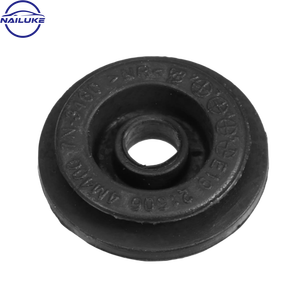
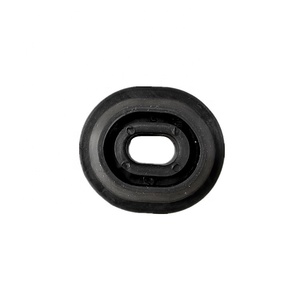
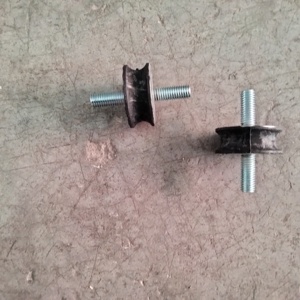
Elastomeric Dynamics & Anti-Vibration Isolation Mechanics
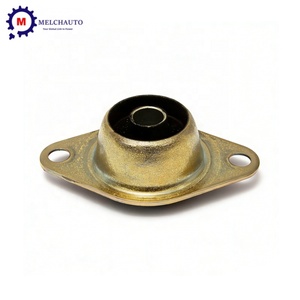
A radiator mount is not a simple passive rubber buffer; it is a critical mechanical interface designed to decouple fragile aluminum-plastic heat exchangers from structural chassis twist, cyclic thermal shock, and high-frequency road vibrations.
Thermodynamic & Fluid Degradation Resistance
Cooling compartments routinely expose mounting points to operational temperatures fluctuating between -40°C and +140°C, accompanied by accidental coolant mist (ethylene glycol/water mixtures), engine blow-by hydrocarbons, and airborne ozone. Under our proprietary peroxide-cured EPDM formulations, cross-link density is balanced to prevent post-cure embrittlement, stress cracking (ASTM D518), and excessive tensile loss under cyclic thermal aging.
Dynamic Resonance & NVH Decoupling
Radiators possess characteristic natural vibration frequencies typically between 20 Hz and 70 Hz. If chassis road input or diesel idle rumble excites this frequency band, unattenuated resonance accelerates fatigue fracture on radiator plastic end-tanks and brazed tube-to-header joints. Our mounts feature optimized loss factors (tan δ) engineered through custom carbon black compounding, preventing transmissibility spikes across critical operational harmonics.
Chemical Metal-to-Rubber Vulcanization
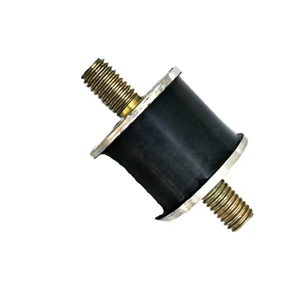
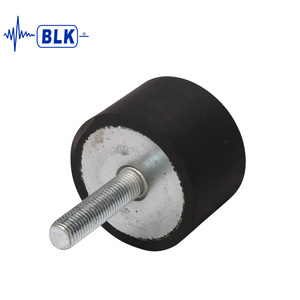
For stud-mounted and sleeve-reinforced variants (e.g., Perkins gensets, Scania buffers), structural failure universally originates at the bonding boundary. We apply two-coat organosilane and phenolic primer systems onto degreased, grit-blasted steel cores. During high-pressure transfer molding, simultaneous vulcanization creates a cohesive covalent bond exceeding 12 MPa peel strength (ASTM D429 Method B), eliminating debonding risks under maximum transverse vehicle shear.
| Elastomer Compound | Hardness (Shore A) | Tensile Strength (MPa) | Elongation at Break (%) | Working Temp Range (°C) | Compression Set (22h @ 100°C) | Primary Target Applications |
|---|---|---|---|---|---|---|
| Peroxide-Cured EPDM | 55 ± 5 to 70 ± 5 | ≥ 14.5 | ≥ 420% | -45°C to +140°C | ≤ 18% | Automotive & Heavy Truck OEM Radiators |
| High-Damping Natural Rubber (NR) | 50 ± 5 to 65 ± 5 | ≥ 18.0 | ≥ 520% | -40°C to +85°C | ≤ 22% | High-Amplitude Industrial Stationary Gen-Sets |
| Fluorosilicone / VMQ Hybrid | 60 ± 5 | ≥ 9.5 | ≥ 320% | -60°C to +200°C | ≤ 15% | Extreme Motorsport & Specialized Defense Chassis |
| Cast Microcellular PU | 70 ± 5 to 85 ± 5 | ≥ 22.0 | ≥ 380% | -35°C to +95°C | ≤ 25% | Heavy Off-Highway & Mining Haulage Equipment |
Procurement & Supply Chain Trends for Commercial Mounts (2025–2030)
Global tier-1 aftermarket distributors, OEM assemblers, and international fleet groups face shifting compliance mandates, supply volatility, and technological transitions. Understanding these structural industry shifts guarantees strategic procurement resilience.
1. Stringent CE, REACH & PAH Restrictions
European regulatory authorities have tightened limits on Polycyclic Aromatic Hydrocarbons (PAHs), phthalate plasticizers, and SVHCs under EU REACH Regulation (EC) No 1907/2006. Low-cost rubber products compounded with unregulated aromatic extender oils are increasingly intercepted at customs borders. Forward-thinking procurement teams require CE, RoHS, and fully certified lab test documentation verifying zero hazardous migration before contract signing.
2. Electric Vehicle & Hybrid Thermal Architecture
The transition toward BEV (Battery Electric Vehicles) does not eliminate radiator mounts; it increases thermal management density. Modern electric drivetrains incorporate low-temperature radiators (LTR), dual battery chillers, and power electronics cooling loops. These systems exhibit higher mass loads concentrated in tighter engine bay packaging, demanding mounts with higher durometer precision, zero electrical conductivity (galvanic isolation), and enhanced acoustic attenuation.
3. Multi-Sourcing & Value-Chain Nearshoring
Supply chain disruptions have driven global distributors away from single-region dependency. Tier-1 buyers are diversifying purchase orders to established Indian manufacturing hubs with proven polymer infrastructure, such as Delhi's Kashmere Gate ecosystem. Manufacturers providing direct engineering communication, rapid tooling turnarounds (under 25 days), and bonded inventory arrangements offer superior agility against global logistical friction.
Technological Trajectories in Industrial Rubber Molding
Modern radiator mounts have evolved from rudimentary compression-molded rubber blocks into high-precision, automated components manufactured with tight dimensional tolerances and non-linear computational validation.
Automated Vacuum Injection Molding
Legacy compression molding frequently suffers from trapped air voids and inconsistent wall thicknesses, creating latent failure points under heavy cyclic shear. State-of-the-art cold-runner vacuum injection presses extract microscopic air pockets before elastomeric filling. This ensures 100% molecular density, uniform cross-sectional cure states, and minimal mold parting flash for true OE-grade aesthetic and physical consistency.
FEA Non-Linear Elastomer Simulation
Hyperelastic behavior cannot be accurately mapped with conventional linear Hookean stress equations. Contemporary mount engineering utilizes Mooney-Rivlin and Ogden strain energy density functions in 3D Finite Element Analysis (FEA). This digital prototyping simulates multi-axis chassis twisting, maximum braking shock loads, and structural radiator neck deflection prior to cutting mold steel, cutting development lead times by over 40%.
Automated Surface Phosphating & Bonding
To combat galvanic corrosion and rust propagation on metal-insert radiator buffers, robotic preparation lines apply multi-stage zinc-iron phosphating followed by continuous electro-dip e-coating. This process achieves over 1,000 hours of neutral salt spray resistance (ASTM B117), guaranteeing that the metal insert retains structural anchoring throughout severe sub-zero salt-slush winter highway conditions.
Why Global Importers Partner with Amit Rubber Products
Since 1980, Amit Rubber Products has engineered and supplied heavy-duty commercial vehicle chassis, cooling, and driveline rubber components. Headquartered in Delhi's premier automotive enclave, we bridge genuine OE-fit geometry with export-competitive economies of scale.
Over 4 Decades Track Record
Under the continuous engineering leadership of Mr. Amit Chitkara, our facility blends decades of hands-on polymer compounding experience with rigorous dimensional cross-checks.
Global Export Markets
Supplying heavy haulage distributors, municipal bus authorities, and agricultural fleet parts wholesalers across Europe, Africa, the Middle East, South America, and Asia.
Tooling & Mold Repository
Comprehensive dies spanning Nissan, VAG, Porsche, Perkins, Scania, Tata, Ashok Leyland, Mahindra, and universal industrial generator mounts ready for immediate series batch production.
Batch-Inspected Reliability
In-house rheometer tensile evaluation, Shore A durometer hardness verification, and cyclic compression testing prior to export consignment packaging and maritime shipping.
Direct Factory Procurement
Eliminate middleman trading markup. Source directly from our manufacturing infrastructure with guaranteed batch-to-batch polymer traceability, custom color coding, and laser-etched OEM numbers.
Custom Compound Formulation
Whether your application requires high-rebound natural rubber for stationary diesel gen-sets or high-temperature peroxide EPDM for turbocharged heavy commercial trucks, our chemists tailor formulations to your target climate and load curve.
Rapid Prototype & Tooling Turnaround
Have an obsolete reference, a specialized bus bracket, or an emergency fleet breakdown? Share physical samples or 2D/3D CAD drawings. We engineer custom tooling and dispatch pilot evaluation samples in under 20 business days.
Radiator Rubber Mount Procurement & Technical FAQ
Key technical and commercial answers designed for procurement managers, automotive engineers, and international spare parts importers.
How do I confirm cross-reference compatibility for damaged OEM mounts without part numbers?
When part numbers are illegible, send clear photos showing critical dimensions: outer diameter (OD), inner bore/bush diameter (ID), overall height, mounting collar lip width, and bracket pin spacing. Our technical database cross-checks dimensions against European, Japanese, American, and Indian vehicle chassis schematics to confirm exact fitment.
What testing documentation and CE compliance certificates accompany export orders?
All export shipments are accompanied by a complete Material Inspection Certificate (EN 10204 Type 3.1 on request), including Shore A durometer hardness verification, tensile strength, elongation at break, and ASTM D395 compression set test data. CE, RoHS, and EU REACH compliance documentation is standard for international shipments.
Why is EPDM rubber favored over natural rubber for automotive radiator mounts?
Natural Rubber (NR) offers excellent dynamic elasticity and high mechanical tear strength, making it ideal for large stationary generators. However, NR deteriorates rapidly when exposed to hot glycol coolant splash, atmospheric ozone, and under-hood temperatures exceeding 80°C. EPDM offers superior resistance to thermal oxidation, ozone micro-cracking, and chemical attack up to 140°C.
What is the standard production lead time and Minimum Order Quantity (MOQ)?
For catalogued fast-moving parts (such as Nissan Qashqai, VW 1K0121367F, Perkins, and Scania buffers), ready stock is dispatched within 3 to 7 business days. For customized formulations, branded private-label packaging, or custom mold fabrication, our typical MOQ ranges from 500 to 2,000 units depending on geometry, with a tooling lead time of 15 to 25 days.
How does improper radiator mount durometer cause premature cooling system failure?
If a replacement mount is molded too hard (e.g., Shore A 85 instead of 60), it fails to isolate high-frequency road vibrations, transmitting continuous cyclical stress into the aluminum radiator core and fracturing header braze joints. Conversely, a mount that is too soft allows excessive radiator travel, leading to fan shroud contact and hose neck breakage.
How are rubber parts packaged to prevent deformation and degradation during ocean transit?
To avoid permanent compression deformation and ozone exposure during multi-week ocean transit, our radiator mounts are packed in sealed, UV-blocking polyethylene bags, boxed in reinforced 5-ply corrugated master cartons, palletized on heat-treated ISPM-15 wooden pallets, and edge-protected with heavy-duty stretch wrapping.
Connect with Amit Rubber Products Technical Sales Engineering
Request sample packages, volume-tiered export discount schedules, or custom CAD design consultations directly from our factory engineering team.
Get Catalog