Welcome to Amit Rubber Products — Automotive Rubber Parts Manufacturer Since 1980[email protected]+91-9871861285
FacebookXLinkedInInstagramYouTubeWhatsApp
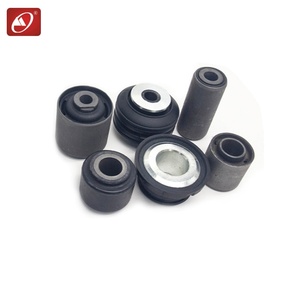
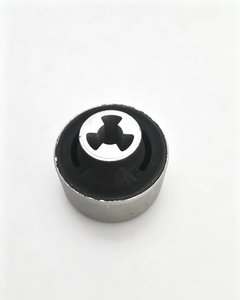
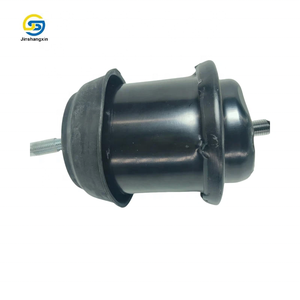
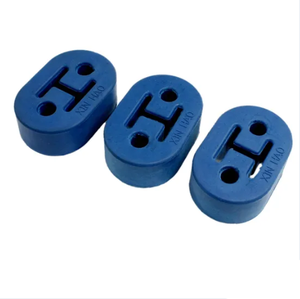
OEM/ODM Rubber Damping Block Factories & Supplier
Precision-Formulated Elastomeric NVH Solutions, High-Temperature Dynamic Dampers, and Polyurethane Mechanical Isolators for Global Automotive and Heavy-Duty Machinery Platforms
A deep dive into dynamic loss factors, polymer cross-linking, and anti-vibration damping performance under severe duty cycles.
1. Fundamental Elastomer Rheology & The Loss Factor (tan δ)
In dynamic mechanical analysis (DMA), a rubber damping block is defined not simply by static load-bearing capacity, but by its viscoelastic dissipation of mechanical energy into thermal energy. The loss factor, characterized by tan δ = E'' / E' (where E'' represents the loss modulus and E' represents the storage modulus), dictates the efficiency of shock mitigation across specific frequency bands. Standard natural rubber (NR) formulations feature a lower glass transition temperature (Tg ≈ -70°C) offering excellent cold-weather elasticity and dynamic resilience with tan δ ranges between 0.05 and 0.15.
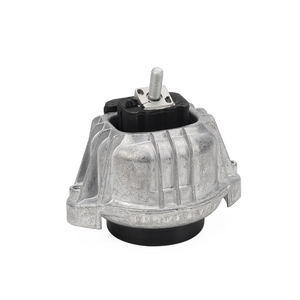
For heavy-vehicle engine mountings, cab suspensions, and drivetrain center bearing supports, excessive resonance amplification requires controlled hysteresis damping. Through customized carbon black (N330/N550) filler networks and silane-coupling functionalization, our OEM formulation adjusts tan δ to peak values (>0.25) across critical powertrain vibration bands (20 Hz to 200 Hz), preventing structural fatigue on chassis brackets and cross-members.
2. Comparative Polymer Matrix Selection for Heavy Industrial & Automotive Isolation
Selecting the appropriate elastomeric matrix requires a thorough evaluation of environmental thermal degradation, hydrocarbon exposure, ozone exposure, and dynamic shear fatigue:
Elastomer Type
Operating Temp Range
Dynamic Loss Factor (tan δ)
Oil & Solvent Resistance
Primary Application Profile
Natural Rubber (NR)
-50°C to +85°C
0.05 – 0.18 (High Resilience)
Moderate / Low
Axle control arm bushings, fifth wheel isolators, suspension dampers
EPDM Terpolymer
-45°C to +140°C
0.12 – 0.28 (Moderate)
High (Glycols/Ozone)
Radiator mounts, cooling line vibration decouplers, cabin seals
Heavy-haul trailer pivots, torque rod sleeves, circular PU bushes
3. Rubber-to-Metal Chemical Bond Integrity (Chemlok® Systems)
The weakest link in composite damping blocks is rarely the cured elastomer itself, but the interphase between the polymer matrix and the rigid metallic substrate. Our factory adheres strictly to automated five-stage phosphating and degreasing protocols, followed by electrostatic primer and cover-coat deposition (utilizing proven aqueous or solvent-based organosilane Chemlok adhesive architectures). During high-pressure hydraulic transfer vulcanization (160°C – 180°C at 15–20 MPa), cross-linking sulfur chains traverse the substrate boundary, creating a chemical interlock that exceeds standard ASTM D429 Method B 90-degree peel requirements, yielding 100% rubber cohesive failure rather than adhesive separation.
Global Procurement Trends: Strategic Sourcing for 2025–2030
How fleet managers, tier-1 system integrators, and OEM distributors are re-engineering their supply chains.
TCO & Preemptive Life-Cycle Metrics
Procurement teams are moving away from unit-purchase-price evaluation. In commercial fleet applications, the labor costs and operational downtime associated with prematurely replacing failed engine mounts or trailer balance rod bushes far outweigh initial component costs. Sourcing shifts toward elastomeric compounds that guarantee a minimum 500,000 km MTBF (Mean Time Between Failures) under multi-axial cyclic loading.
Direct Factory Tooling Interoperability
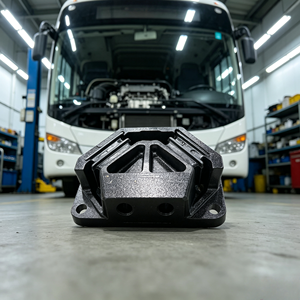
To counter international logistics friction, global buyers require manufacturing partners capable of rapid rapid-tooling iterations. Utilizing 3D CAD step-file exchanges, FEA (Finite Element Analysis) compound modeling, and standard CNC mold fabrication, our engineering team compresses prototype-to-production cycles from 16 weeks down to under 21 calendar days for bespoke bus and truck brackets.
Decoupled Dual-Sourcing & Compliance
Strict enforcement of EU RoHS, REACH-SVHC, and North American supply chain audits requires comprehensive chemical lineage traceability. Global importers demand certified vulcanization records, polycyclic aromatic hydrocarbon (PAH) compliance, and heavy-metal-free surface plating (zinc-nickel or eco-phosphate) on all metal bonding surfaces.
Technological Horizons: Future of Rubber Damping Blocks
Emerging advancements transforming structural vibration attenuation across heavy transportation and electric vehicles.
EV High-Torque Transient Dampening
Electric drivetrains eliminate internal combustion harmonics but introduce instantaneous torque spikes (zero-RPM maximum torque) and high-frequency inverter whine (1 kHz to 8 kHz). Next-generation damping blocks integrate asymmetric progressive stiffness geometries that deliver ultra-plush low-amplitude isolation while stiffening exponentially under full torque application.
Bio-Circular Elastomer Formulation
In line with circular economy initiatives, dynamic damper production is integrating recovered carbon black (rCB) derived from end-of-life tire pyrolysis, alongside bio-silica derived from rice husk ash. When vulcanized with sulfur accelerators, these sustainable compound architectures match prime synthetic polymers in dynamic tear strength (>45 kN/m) without degradation in compression set.
Active & Semi-Active MR Mounts
The line between passive rubber blocks and adaptive suspension components is blurring. Forward-looking designs couple elastomeric chambers with magnetorheological (MR) fluids or hydraulic decoupling valves, adjusting damping rates in milliseconds based on chassis CAN-bus accelerometer feedback.
Why Partner With Us: Direct Manufacturing Authority
Built upon a foundational legacy spanning over four decades in high-stress commercial vehicle elastomeric manufacturing.
46+ Years Industrial Provenance (Since 1980)
Founded in 1980, our deep institutional knowledge covers thousands of commercial platform applications—from Tata (407, 709, 1613, 2515, Signa, Prima) and Ashok Leyland U-Trucks to Marcopolo bus chassis, Mahindra utility platforms, and heavy agricultural machinery. We understand operational load dynamics and real-world failure modes.
Comprehensive Custom Tooling & Polyurethane Line
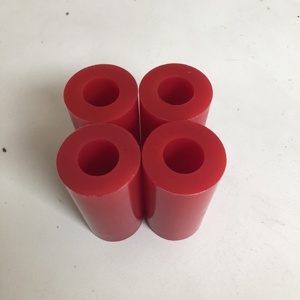
Beyond conventional vulcanized rubber blocks, our facility operates specialized polyurethane (PU) reaction-injection and casting lines. From circular 5-inch red PU suspension bushes to 40mm heavy torque-rod cut-bushes, we provide customized Shore A formulations tuned for extreme wear scenarios where traditional rubber degrades.
Comprehensive Physical & Dimensional Inspection
Every batch undergoes rigorous quality assurance: Durometer Shore testing, tensile elongation verification (ASTM D412), compression set testing (ASTM D395 Method B), and mechanical coordinate validation of bracket hole pitches. We guarantee zero wrong-fit returns and immediate dispatch of high-velocity catalog inventory.
Technical Procurement FAQ
Direct engineering answers addressing material specifications, reverse engineering, and global logistics.
Can you reverse-engineer damping blocks from physical samples?
Yes. By utilizing coordinate measuring machines (CMM), 3D optical scanning, and thermogravimetric analysis (TGA) for polymer identification, we accurately determine core bracket geometry, elastomer durometer, and compound matrix chemistry directly from your submitted worn or OEM sample part.
How do you prevent dynamic rubber-to-metal bond separation?
We treat all metallic inserts through multi-stage alkaline degreasing, zinc phosphating, and controlled application of polymeric Chemlok bonding systems. Vulcanization parameters are continuously monitored via computerized rheometer curves to achieve complete cross-linking and 100% cohesive failure integrity.
What parameters are required to quote a custom OEM damping component?
To deliver an accurate quote and material evaluation, please provide: 2D/3D part drawings with tolerances, static operating load (kN), peak dynamic shock acceleration, ambient thermal range, required elastomer type/hardness (or oil-exposure profile), and estimated annual procurement volumes.
What is the typical tooling and mass production lead time?
Standard prototype tooling and pilot sample delivery require 14 to 21 calendar days. Upon pilot verification, complete multi-cavity production tooling and initial mass export dispatches are typically fulfilled within 30 to 45 days, supported by buffer stocking programs for contracted distributors.
Initiate Your Custom OEM/ODM Elastomeric Project
Connect directly with our engineering department to discuss compound tailoring, dimensional specifications, or wholesale batch deliveries.