1980
Engineering Since
46+ Years
Rubber Compound Mastery
20+ Countries
Global Export Reach
1.5M+ Cycles
Dynamic Fatigue Life
Featured Product Portfolio
Engineered Dust Boots, Gaiters & Heavy-Duty Protective Solutions
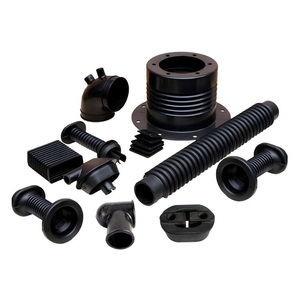
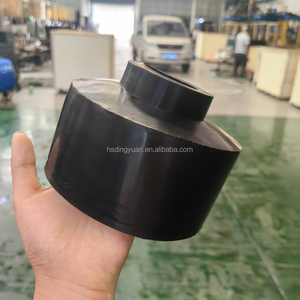
Explore our high-performance OE-matching rubber dust boots and custom-engineered elastomeric protection sleeves. Molded from premium synthetic rubbers, fluoroelastomers, and thermoplastic elastomers to withstand critical operational deflections, environmental contamination, and high cyclic fatigue.
Technical Whitepaper
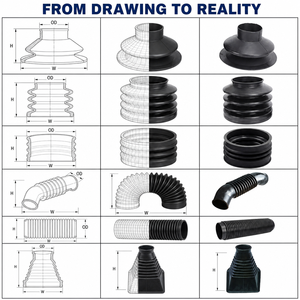
Engineering Fundamentals: Polymer Chemistry & Convolution Geometry in Dust Boot Design
In mechanical assemblies, the rubber dust boot (frequently designated as an elastomeric bellow, steering rack gaiter, or CV joint protective boot) serves as the primary barrier preventing abrasive particulates, salt spray, moisture, and road contaminants from entering dynamic interfaces while hermetically encapsulating critical lubricating grease. The failure of a dust boot is rarely benign; microscopic punctures or premature cyclic cracking cause grease purge, precipitating catastrophic failure in ball joints, rack-and-pinion steering mechanisms, and constant velocity driveshafts.
As an OEM/ODM tier manufacturer and global exporter, Amit Rubber Products adheres to strict finite element analysis (FEA) principles when determining wall thickness profiles, convolution convolutions root radii, and elastomeric compound formulations. Rubber boots cannot merely stretch; they must expand, compress, bend, and withstand continuous torsional shear without inducing high localized stress concentrations that trigger fatigue micro-fissures.
Key Design Checkpoint: Dynamic Fatigue vs. Hysteresis Build-up
Under cyclic compression and high angular deflection, inferior elastomer compounds generate substantial internal friction (hysteresis heat build-up). In enclosed driveline boots, internal air temperatures can rapidly reach +110°C. Without tailored anti-degradant packages, ozone inhibitors, and stabilized cross-linking agents, the polymer chains suffer thermo-oxidative scission, resulting in hardening, embrittlement, and rapid convolution collapse.
Elastomeric Polymer Compound Selection Matrix
Specifying the proper elastomer formulation is an essential engineering gate in OEM/ODM production. The table below represents our empirical compounding performance standards across high-demand industrial and automotive operating parameters:
| Polymer Compound | Standard Hardness (Shore A) | Operating Temp Range | Grease / Oil Resistance | Ozone / Weathering | Primary Application Niche |
|---|---|---|---|---|---|
| NBR (Nitrile Butadiene) | 55 – 75 ±5 | -30°C to +110°C | Superior | Moderate (Requires Wax/Antiozonant) | CV joint boots, differential output seals, grease-packed gear linkages |
| CR (Polychloroprene / Neoprene) | 50 – 70 ±5 | -40°C to +125°C | Good | Excellent | Steering rack boots, heavy-duty truck axle gaiters, chassis ball joints |
| EPDM (Ethylene Propylene) | 60 – 80 ±5 | -45°C to +145°C | Poor (Mineral Oil Incompatible) | Outstanding | Brake caliper slide pin boots, hydraulic damper boots, HVAC actuator bellows |
| VMQ (Silicone Elastomer) | 40 – 70 ±5 | -60°C to +200°C | Moderate | Superior | Extreme temperature turbo linkages, motorsports suspension, sub-zero aerospace |
| TPE / TEE (Thermoplastic Elastomer) | 85 – 95 Shore A / 40D | -40°C to +130°C | Excellent | Outstanding | Next-generation lightweight CV joint boots, high-speed rotational driveshafts |
Industry Whitepaper
Technological Innovations & Development Trends in Rubber Dust Boots
The transition toward electric mobility, autonomous heavy haulage, and intelligent robotics is fundamentally altering the engineering demands placed on elastomeric seals and dynamic gaiters.
1. Electric Vehicle (EV) Instantaneous Torque & NVH Dynamics
Electric powertrains deliver maximum torque at zero RPM, generating intense rotational acceleration and immediate torsional shear forces. Dust boots on EV half-shafts encounter higher rotational speeds with minimal airflow cooling. Modern boot manufacturing utilizes high-modulus, blow-molded thermoplastic polyether ester elastomers (TEEE) to prevent boot ballooning under centrifugal forces exceeding 2,500 RPM.
2. Advanced Non-Linear FEA Convolution Simulation
Eliminating mold modification iterations is now standard. Advanced non-linear elastomeric simulation models calculate localized strain energy density across every convolution valley during compound angulation. By optimizing variable wall thicknesses—thicker at mounting clamp necks and thinner along working diaphragms—fatigue life is consistently elevated beyond 1,500,000 dynamic articulation cycles.
3. Bio-Based Monomers & Low-Carbon Vulcanization
Tier-1 automotive OEMs are mandating verified lifecycle emissions reductions. Emerging trends center on sulfur-cured EPDM synthesised from bio-ethanol-derived ethylene, paired with eco-friendly silica filler reinforcement instead of traditional carbon blacks. Zero-nitrosamine vulcanization accelerators ensure complete compliance with EU REACH and RoHS environmental standards.
Procurement Insights
Future Procurement Trends for OEM/ODM Rubber Components
Global supply chain executives, industrial buyers, and aftermarket distributors are reshaping how elastomeric components are sourced, qualified, and buffered against volatility.
Procurement directors in 2026 and beyond are moving away from single-source reliance and spot-market purchasing toward strategic, vertically integrated manufacturing partnerships. In the precision rubber sector, where custom tooling, compound consistency, and dynamic testing dictate field reliability, global sourcing is guided by four overarching procurement methodologies:
1. Stringent PPAP Level 3 & IMDS Auditing
Procurement teams no longer accept generic certificates of conformance. Overseas procurement now requires full Production Part Approval Process (PPAP Level 3) packages, including Failure Mode and Effects Analysis (FMEA), Control Plans, dimensional balloon drawings, and IMDS material compliance logging to ensure zero hazardous substances.
2. Total Cost of Ownership (TCO) vs. Piece Price
A failed $1.50 dust boot can compromise a $600 steering gear or result in crippling factory vehicle warranty callbacks. Progressive procurement departments quantify elastomeric aging durability, ozone resistance (ASTM D1149), and abrasion tolerance, actively rewarding manufacturers who utilize virgin synthetic rubbers rather than high-reclaim blends.
3. Tooling Amortization & Dual-Cavity Scalability
Long-term contract procurement requires robust mold design. Sourcing leaders prioritize exporters with in-house tooling manufacturing capabilities. Multi-cavity injection molds with beryllium-copper cooling inserts ensure tighter dimensional control on sealing bead diameters (±0.10mm) and deliver scalable unit economics as vehicle production volumes ramp up.
4. Strategic Supply Chain Diversification
Sourcing managers are actively building dual-hub supply resilience, leveraging advanced manufacturing powerhouses in India to mitigate geopolitical risks and tariff fluctuations. Established hubs like New Delhi offer sophisticated chemical supply chains, skilled mold engineers, and direct maritime logistics routes to European, Middle Eastern, and North American distribution centers.
Enterprise Authority
Amit Rubber Products: Over Four Decades of Elastomeric Manufacturing Mastery
Founded in 1980 in Delhi's premier automotive hub, Amit Rubber Products brings exceptional technical expertise, custom molding capabilities, and trusted international supply chains to the global rubber industry.
Engineering Precision from Delhi to the World Market
Under the leadership of Mr. Amit Chitkara, Amit Rubber Products has grown from an OE-matching replacement specialist into an international manufacturer and wholesale exporter of mission-critical automotive rubber and polyurethane components. Our technical catalog spans centre bearing assemblies, reinforced EPDM radiator hoses, high-temp silicone turbo pipes, heavy-duty engine mountings, and specialized rubber dust boots for commercial vehicles, tractors, combine harvesters, and passenger cars.
Distributors and OEM purchasers across more than 20 countries rely on our components because we never compromise on chemical formulations. Every batch is vulcanized under regulated temperature and pressure parameters, guaranteeing uniform tensile elasticity, exact durometer hardness, and leak-free sealing performance.
46+ Years of Proven Field Reliability
Established in 1980. Our specialized compounding recipes and dynamic tooling methods have withstood decades of real-world road and industrial trials.
Full OEM/ODM Drawing & Sample Matching
Send your OE part number (e.g., Tata, Leyland, Bolero, Signa), CAD file (STEP/IGES), or worn physical sample. Our engineering team matches exact bore sizes, clamp lip beads, and bend angles.
End-to-End Batch Quality Assurance
From rheometer cure curves and ASTM D395 compression set testing to ozone exposure and tensile elongation verification, quality remains our absolute first checkpoint before packing.
High Inventory & Expedited Global Dispatch
We maintain an extensive rolling buffer of fast-moving catalog references at our Kashmere Gate facilities, facilitating rapid air and sea consignments that minimize assembly downtime.
Procurement FAQ
Frequently Asked Questions: Technical Sourcing, Tooling & Specifications
Direct technical answers to common queries from automotive procurement managers, quality engineers, and international distributors.
What precise technical parameters are needed to reverse-engineer or customize a rubber dust boot? +
To produce an exact-fit custom dust boot or gaiter, our engineering team requires: (1) Inner diameters of both mounting necks (small end for shaft/rod, large end for housing); (2) Maximum stroke (extended length, static installation length, and fully compressed length); (3) Maximum angular misalignment/articulation angle; (4) Operating chemical environment (type of grease, exposure to synthetic hydraulic fluids, fuels, or road salts); (5) Continuous and peak temperature ranges; and (6) Clamp retention profile requirements (e.g., internal bead groove or flat clamp seating).
How do you prevent ozone cracking and premature embrittlement in dynamic boots? +
Ozone degradation attacks the unsaturated double bonds in elastomer polymer backbones, especially under mechanical stress. Amit Rubber Products compounds its outdoor and under-chassis formulations with specialized microcrystalline and paraffinic antiozonant waxes, paired with p-phenylenediamine chemical antiozonants. For demanding specifications, we utilize saturated polymer chains such as EPDM, hydrogenated nitrile (HNBR), or chloroprene (CR) blends tested per ASTM D1149 (50 pphm ozone concentration at 40°C for 72 hours without cracking).
What are the standard lead times for custom injection molds and prototype samples? +
For custom OEM/ODM bellows and boots, our standard mold development timeline is: CAD 3D modeling and dynamic FEA convolution validation within 3 to 5 business days; mold tooling fabrication (CNC EDM tool steel P20 or 718) within 15 to 22 business days; First Article Inspection (FAI) prototype samples and initial dimension reports within 5 business days post-tooling. Full mass production dispatch can typically begin 10 to 14 days following client sample approval.
Can your factory supply dust boots with integrated metal inserts or molded clamp rings? +
Yes. We have dedicated rubber-to-metal bonding manufacturing lines. Utilizing proprietary Chemlok / Megum adhesive bonding systems alongside automated grit-blasting and phosphatizing pretreatment of metal inserts (mild steel, stainless steel, or aluminum), our molded boots achieve bond strengths superior to the tear strength of the elastomer itself (100% rubber-tearing failure per ASTM D429 standards).
What is the minimum order quantity (MOQ) for catalog parts versus new custom tooling? +
For catalogued standard references across our existing Tata, Leyland, Mahindra, or universal commercial-vehicle ranges, minimum order quantities can be as low as 100 to 500 units per line item to support distributor warehousing. For newly tooled custom OEM designs, MOQs typically range from 1,000 to 5,000 units depending on part geometry, cavity yield per press, and material compound type.
How does your quality control lab verify dynamic flex life and cyclic fatigue resistance? +
Every dynamic boot design undergoes rigorous bench testing on automated multi-axis articulation rigs. The boots are clamped under internal grease pressure, positioned at their maximum design deflection angle (up to 45°), and articulated at frequencies up to 5 Hz under controlled temperature chambers (-40°C to +120°C). Production batches must demonstrate zero convolution pinching, wall rubbing, or pinhole fatigue through a minimum of 1,000,000 continuous cycles.