Factory Catalog Showcase
High-Performance Bushings & Powertrain Isolation Systems
Engineered for high-torsion commercial vehicles, specialized fleet platforms, and stringent OEM dynamic tolerances.
Technical Authority
Structural Elastomer Science: Motor Mount Bushing Mechanics
A deep dive into tri-axial dynamic stiffness, vulcanization kinetics, and chemical matrix integrity for engineering procurement executives.
Polymer Vulcanization Kinetics
Modern engine mount bushings must survive dynamic shear stress exceeding 12 MPa. Premier Chinese manufacturing facilities utilize high-purity cis-1,4-polyisoprene synthetic natural rubber coupled with semi-EV (Efficient Vulcanization) sulfur-donor crosslinking networks. This chemical configuration limits permanent compression set below 18% after 1,000 thermal-aging hours at 100°C.
Metal-Elastomer Chemlok® Bonding
Delamination at the rubber-to-metal interface is the primary failure mode of powertrain damping hardware. State-of-the-art factories employ automated phosphating shot-blast treatments followed by dual-layer Chemlok® primer-adhesive application. Bond peel resistance exceeds ASTM D429 Method B standards, enforcing 100% rubber-tearing failure modes over adhesive separation.
Cast Polyurethane Alternative Matrices
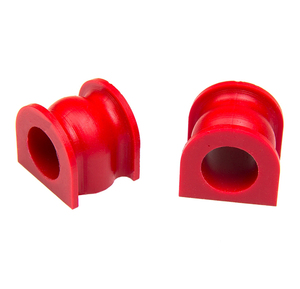
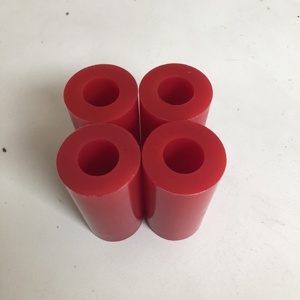
For ultra-high load applications (mining trucks, heavy off-highway equipment, racing drivetrains), thermoset MDI/TDI cast polyurethanes provide four times the tensile resilience of traditional elastomers. Formulated across 65A to 95A Shore durometers, custom PU bushes eliminate drivetrain deflection and chassis lash under instantaneous torque transfer.
| Elastomeric Profile | Dynamic-to-Static Ratio (Kd/Ks) | Tensile Strength (MPa) | Operating Temperature | Primary Industrial Use-Case |
|---|---|---|---|---|
| Natural Rubber (NR / Synthetic Blend) | 1.2 – 1.4 (Low acoustic resonance) | > 22 MPa | -40°C to +90°C | Passenger Car & Heavy Truck Engine NVH Isolation |
| EPDM (High-Ethylene Terpolymer) | 1.5 – 1.8 (Medium acoustic dampening) | > 14 MPa | -45°C to +135°C | Extreme Heat Engine Compartments & Coolant Pipes |
| Thermoset Polyurethane (PU / MDI) | 2.0 – 2.5 (Firm dynamic displacement) | > 38 MPa | -35°C to +85°C | High-Load Suspension, Balance Rods & Racing Mounts |
| Hydraulic Fluid-Filled Dual Cavity | Frequency-dependent tuning (Adaptive) | > 18 MPa (Elastomer) | -40°C to +110°C | Luxury Vehicle Transaxle & 3-Cylinder High-Vibration ICE |
Market Intelligence
Future Procurement Trends in Powertrain Mounting Systems
How Tier-1 automotive procurement leaders and heavy-machinery distributors are structuring supply contracts for 2026–2030.
Electric Vehicle Subframe & E-Drive Isolation
Electric propulsion shifts acoustic frequencies. Without combustion engine masking, high-frequency motor whining (800 Hz to 4 kHz) directly penetrates the cabin. Procurement volume in China is pivoting rapidly toward secondary acoustic decoupled bushings engineered with dual-density polyurethanes and specialized internal chambers tailored for electric transaxles.
Lightweighting: Structural Polyamide Housings
Forged steel and die-cast aluminum outer brackets are being superseded by injection-molded 50% glass-fiber reinforced polyamides (PA66-GF50). These composite housings deliver a 35% weight reduction while preserving structural yield strength, driving down international sea-freight logistics overhead and supporting total vehicle carbon abatement quotas.
Digitized Lifecycle & Accelerated Quality Auditing
Global buyers now bypass brokers to integrate directly with ISO/IATF 16949-certified factories capable of supplying laser-etched matrix serialization, non-destructive ultrasonic elastomeric bond scanning, and PPAP Level 3 documentation with batch rheometer vulcanization telemetry.
Next-Gen Engineering
Technological Frontiers in Bushing Development
The evolutionary trajectory from static elastomeric blocks to frequency-adaptive mechatronic vibration suppression.
46+
Years Industry Heritage
100%
Batch Curing Rheometry
< 15%
Dynamic Drift Variance
20+
Direct Export Territories
Magnetorheological (MR) Adaptive Mounts
Next-generation commercial platforms are validating magnetorheological fluid bushings. By energizing internal electromagnetic coils within milliseconds, damping characteristics transition dynamically between soft compliance (absorbing idle chassis shudder) and extreme dynamic stiffness (countering abrupt torque displacement during full throttle).
Nano-Silica Reinforced Compounds
Replacing standard N220/N330 carbon black with silane-functionalized nano-silica matrices yields an engineered leap in fatigue threshold. Fatigue life under cyclic ±15mm multi-axis displacement tests increases from standard 300,000 cycles to over 1.2 million cycles without vulcanization structural tearing.
FEA-Driven Multi-Chamber Cavitation Analysis
Advanced Chinese tooling factories now deploy non-linear finite element modeling (Abaqus / ANSYS) during mold creation. Pre-optimizing internal fluid bleed holes and rubber contour ribbing minimizes cavitation noise and eliminates localized tensile peaks within the elastomeric bladder before steel cutting.
Since 1980
46+ Years Manufacturing Heritage
Factory Heritage & Scale
Precision Manufacturing, Rigorous Quality, and End-to-End Control
Founded on four decades of deep manufacturing acumen, our operations bridge the gap between heavy-duty commercial demands and precision OEM tolerances. From our core commercial vehicle powertrain hubs to international markets, our infrastructure guarantees consistent component longevity.
- End-to-End Compounding: Internal Banbury mixing and closed-loop calendering ensure strict control over carbon distribution, hardness durometer (±3 Shore A), and dynamic damping specs.
- Broad Vehicle Compatibility: Standardized and bespoke tooling covering Sinotruk Howo, Shacman, Tata, Ashok Leyland, GM, Buick, and specialized industrial platforms.
- Complete Reverse Engineering: Rapid prototype turnaround from physical customer samples or 2D/3D CAD drawings within 15–20 business days.
- Certified Global Dispatches: Immediate container loading of cataloged fast-movers and export-grade sea-worthy packaging across 20+ countries.
Procurement Knowledgebase
Frequently Asked Questions by Industrial Buyers
Essential guidance on minimum orders, elastomeric chemistry selection, and tooling lead times.
How do I determine whether to procure Natural Rubber (NR) or Polyurethane (PU) bushings?
Natural Rubber remains optimal for high-speed dynamic damping and acoustic cabin comfort where noise, vibration, and harshness (NVH) suppression is paramount, such as standard passenger car engine mountings and on-highway commercial truck cabs. Polyurethane (PU) is selected when mechanical tear strength, resistance to hydrocarbon oil saturation, and resistance to dynamic chassis deflection under immense static mass are required, such as heavy suspension control arms, balance rods, and off-highway articulation joints.
Can your factory replicate exact OE specifications using cross-referenced part numbers?
Yes. Our engineering archive cross-references major global OEM codes, including Sinotruk (WG9925590350), Shacman (DZ95259590067), General Motors (25840452), Tata, and Ashok Leyland. We verify inner sleeve sleeve bore, outer metal jacket wall thickness, bracket mounting hole pitch, and vulcanized rubber durometer before initiating high-speed mass production runs.
What are typical production lead times and tooling costs for customized bushings?
For standard tooling modifications, tool fabrication requires 15 to 20 business days. Initial prototype validation samples (T1) are dispatched via air freight with complete dimensional CMM reports. Upon PPAP approval, full-scale batch delivery timelines range from 25 to 35 calendar days depending on container volume and specialized surface treatments (e.g., zinc-nickel plating, e-coating).
What quality control protocols are implemented to guarantee zero bond failure?
Our quality infrastructure enforces three levels of bond security: surface degreasing and grit blasting to Sa 2.5 cleanliness, automated film thickness monitoring for Chemlok® primer/adhesive layers, and destructive 90-degree peel testing (ASTM D429) on every curing batch. Production components must demonstrate 100% cohesive elastomer tearing failure, completely eliminating adhesive interface separation.
What packaging standards are used to prevent rubber degradation during sea freight?
Elastomers are susceptible to UV and ozone oxidation during prolonged maritime transit. All components are treated with an anti-blooming surface wash, sealed within vacuum-gauge UV-inhibiting polyethylene liners, placed in heavy-wall corrugated export master cartons, and palletized with moisture-barrier stretch wrap and rust-inhibiting VCI desiccants.
Connect Directly with Our Sourcing Engineering Team
Accelerate your OEM procurement pipeline. Receive comprehensive PPAP documentation, dynamic stiffness FEA simulations, and transparent volume quotations within 24 business hours.
Inquire Now