Featured Heavy-Duty Front Mounts & Vibration Damping Components
Explore our certified front engine mount assemblies, silent blocks, dynamic dampers, and high-resilience suspension modules engineered for long-haul durability under extreme mechanical and climatic stress.
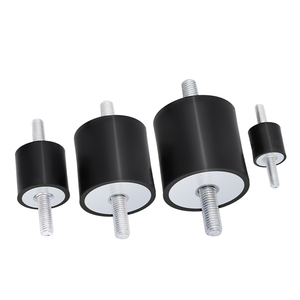
VV-type Rubber Vibration Damper Double Male Thread Anti Vibration Mount
Cylindrical silentblock with dual metric male studs. Features high-tensile rubber-to-metal bonding engineered for auxiliary drives, generator sets, and engine frame brackets operating down to -45°C.
View Part Details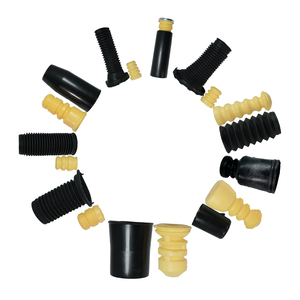
High Quality Steel Hydraulic Shock Absorber Boots for Front/Rear of Cars
Dust-proof, cold-resistant hydraulic strut boots. Safeguards internal dampers and hydraulic seals against aggressive road de-icing salts, slush, mud, and pulverized gravel on unpaved federal routes.
View Part Details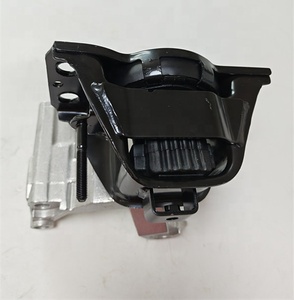
Kabang 11210-EN00B Engine Transmission Mount Metal Structure
Heavy-duty structural engine/transmission cradle mount built with cold-drawn structural steel plates and premium Shore 60A vulcanized rubber. Absorbs longitudinal powertrain torsion during hard braking.
View Part Details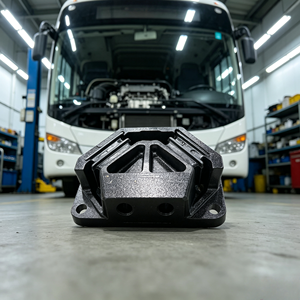
Heavy Duty Vehicle Engine Rear & Front Support Mount Cushion Damping
Engineered for intercity coaches and municipal transit buses (LiAZ, PAZ, MAZ). High natural rubber content delivers high elasticity and dampens secondary high-frequency diesel harmonic resonance.
View Part Details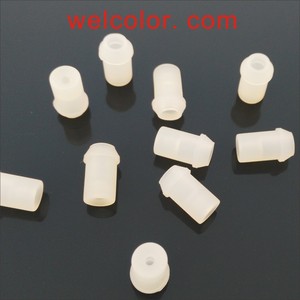
Universal High Temperature Silicone Rubber Exhaust Pipe Muffler Bushing
Designed to withstand tailpipe radiant temperatures over +220°C while retaining elasticity in -50°C sub-zero cold. Eliminates exhaust system stress fracture along corrugated Russian logging roads.
View Part Details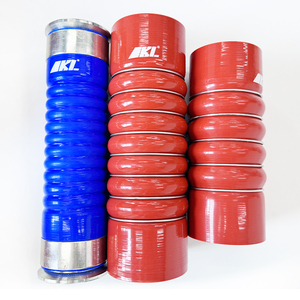
Factory High Temperature Resistance Truck Radiator Intercooler Silicone Hose
Multi-ply polyester/aramid reinforced silicone coolant hose. Unaffected by ethylene glycol coolants, engine bay heat cycles, and rapid thermal shocks during severe Siberian cold starts.
View Part Details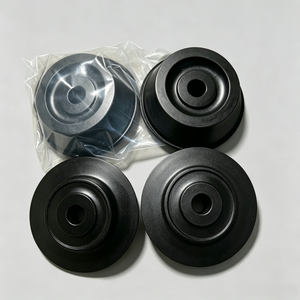
Engine Mount Cushion Vibration Damper 21T-01-11150 for Heavy Excavators
Heavy mining excavator front cushion dampener (PC300/PC650/PC800 6D140E-5). Engineered to isolate massive hydraulic pump vibration and high torque shockwaves in open-pit mining operations.
View Part Details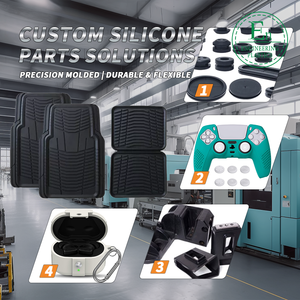
Custom Automotive Rubber Parts Injection Molding Auto Silicone Accessories
OEM-custom elastomeric buffer blocks, cabin stops, and custom mounting dampeners. Tailored to custom drawings with proprietary rubber formulas providing micro-vibration isolation and extreme fatigue resistance.
View Part DetailsElastomeric Dynamics: Front Engine Mounting Performance in Siberian and Eurasian Climes
In modern commercial vehicle dynamics, front engine mountings serve as the principal mechanical interface responsible for managing five critical powertrain stress vectors: static drivetrain mass, longitudinal acceleration/braking shear forces, engine roll torque reaction, high-frequency internal combustion harmonics, and high-impact vertical chassis acceleration induced by damaged road infrastructure. In the Russian Federation, these structural demands are compounded by hyper-severe operational conditions that rapidly destroy standard commercial rubber mountings.
The primary mode of premature engine mounting failure throughout Russia, Belarus, and Northern Kazakhstan is low-temperature elastomer vitrification, also known as the glass transition phase. Standard grade natural rubber (NR) and styrene-butadiene rubber (SBR) compounds begin losing their viscoelastic dampening characteristics at -20°C. When temperatures drop between -35°C and -55°C in federal logistics corridors such as Yakutia, Krasnoyarsk, and the Ural regions, standard rubber hardens into a rigid, brittle glass-state polymer. In this frozen condition, the elastomer can no longer deform elastically under dynamic torque shockwaves. The consequences are immediate: severe transfer of high-amplitude vibrations into the vehicle chassis frame, fracturing of cast-iron engine mounting brackets, cabin acoustic noise exceeding 85 dBA, and rapid delamination along the critical rubber-to-metal vulcanization bonding plane.
| Performance Parameter | Standard Commercial Rubber Mount | Amit Arctic-Grade NR/PBR Blend | Engineered Polyurethane (Arctic Spec) |
|---|---|---|---|
| Glass Transition Temp ($T_g$) | -25°C to -30°C (Brittle failure risk) | -55°C to -60°C (Continuous elasticity) | -45°C to -50°C (High load resilience) |
| Rubber-to-Metal Bond Strength | < 6.5 MPa (ASTM D429 Method B) | ≥ 11.2 MPa (Chemlok hot vulcanized) | ≥ 10.5 MPa (Primed mechanical lock) |
| De-icing Salt Resistance (ASTM B117) | 120 hrs before red rust formation | 1,000+ hrs (Geomet / Dacromet steel) | 800+ hrs (Zinc-Nickel alloy coated) |
| Dynamic-to-Static Stiffness ($K_d / K_s$) | 1.8 to 2.4 @ 100 Hz (Harsh cab ride) | 1.25 to 1.45 @ 100 Hz (Optimal NVH) | 1.5 to 1.7 @ 100 Hz (High chassis control) |
| Tensile Strength (MPa) | 14 - 16 MPa | 22 - 26 MPa (High cis-polyisoprene) | 35 - 45 MPa (Extreme tear limit) |
To overcome Arctic elastomer vitrification, Amit Rubber Products formulates front engine mount cushions using a proprietary high-cis 1,4-polyisoprene virgin rubber base blended with specific ratios of solution-polymerized polybutadiene (BR). This vulcanizate is cross-linked using an efficient semi-EV (Equilibrium Vulcanization) sulfur curing package augmented with microcrystalline waxes and low-volatility plasticizers. This precise molecular structure maintains an exceptionally low glass transition temperature of down to -58°C, ensuring consistent static-to-dynamic stiffness ratios even after overnight parking in deep Siberian sub-zero conditions without supplemental pre-heaters.
Furthermore, our metal bracket reinforcement structures are treated with specialized anti-corrosion barrier coatings. Russian municipal clearing fleets utilize severe concentrations of chemical de-icers, notably calcium chloride ($CaCl_2$), magnesium chloride ($MgCl_2$), and liquid bishofit. These chemicals migrate directly onto low-slung front engine cross-members. Our hot vulcanized metal housings undergo multi-stage shot blasting, zinc phosphate chemical washing, dual-coat Chemlok 205/6125 thermo-reactive primer adhesive bonding, and Dacromet corrosion-inhibiting topcoats, exceeding 1,000 hours of continuous ASTM B117 neutral salt spray testing without micro-fissuring or bond line failure.
Localized Application Scenarios Across the Russian Federation
From intercity arterial freight corridors to open-cast Siberian mineral excavation and agricultural harvest fleets, our front engine mounts provide critical vibration isolation across diverse commercial platforms.

Transcontinental Long-Haul Freight
Long-distance haulage along federal expressways (M-11 Neva, M-12 Vostok, M-5 Ural) powering KamAZ-54901, Sitrak C7H, Shacman X3000, and Scania/Volvo European tractor units requiring 500,000 km MTBF mountings.
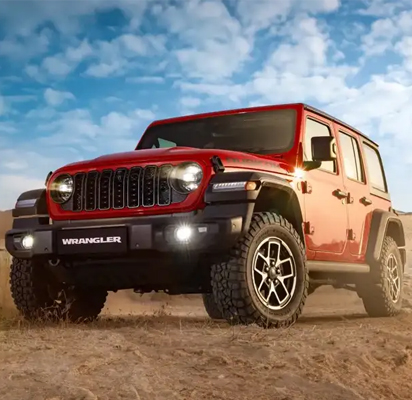
Urban Light Commercial Transport
High stop-and-go parcel distribution and city logistics fleets using GAZelle NEXT, GAZon NEXT, and KAMAZ Compass. Built to mitigate continuous idle chatter and torsional clutch engagement shock.
Municipal Transit & Intercity Buses
Passenger safety and acoustic cabin comfort compliance for LiAZ, PAZ, and MAZ regional buses. Mounts strictly suppress secondary harmonic frequencies to achieve low decibel cab thresholds.
Siberian Mining & Agriculture
Harsh off-road operations including Kuzbass coal basins, Norilsk extraction zones, and Southern Russian grain belts using Rostselmash combines, MTZ Belarus tractors, and heavy quarry tippers.
Russian Commercial Vehicle Market Dynamics & Procurement Trends
Understanding shifting supply chains, localization mandates, and component reliability expectations across Russian wholesale auto-part distributors.
Supply Chain Pivot & Parallel Sourcing
Following Western OEM export restrictions, Russian commercial fleet operators have transitioned heavily toward dual-track sourcing: acquiring reliable aftermarket replacement components for legacy European trucks (Volvo FM/FH, MAN TGX, Scania R-series) alongside OEM and Tier-1 components for rapidly expanding Chinese haulage platforms (Sitrak, Shacman, FAW, Foton). Indian manufacturing provides an established, non-sanctioned, and commercially stable trade corridor.
Demand for Extended MTBF Under Severe Duty
Russian transport enterprises face escalating vehicle replacement costs, forcing fleet managers to extend operational vehicle lifespans past 1,200,000 kilometers. Fleet uptime depends directly on front engine mounting resilience. Sourcing managers now reject sub-standard recycled rubber compounds in favor of chemically characterized virgin natural rubber mounts that reduce unplanned engine drops and driveline misalignments.
Regulatory Compliance: EAC & TR CU 018/2011
Automotive components entering the Eurasian Customs Union (Russia, Belarus, Kazakhstan, Armenia, Kyrgyzstan) must strictly satisfy Technical Regulations TR CU 018/2011 "On Safety of Wheeled Vehicles". Front engine mounts require formal verification of dynamic fatigue resistance, tear strength, metal bracket structural integrity, and chemical safety, requiring rigorous testing and batch-traceable documentation.
Amit Rubber Products: Over Four Decades of Manufacturing Integrity
Operating from New Delhi's historic automotive manufacturing belt since 1980, we offer integrated mold design, precision elastomer formulation, and ISO-standard production controls.
In-House Polymer Compounding & Testing
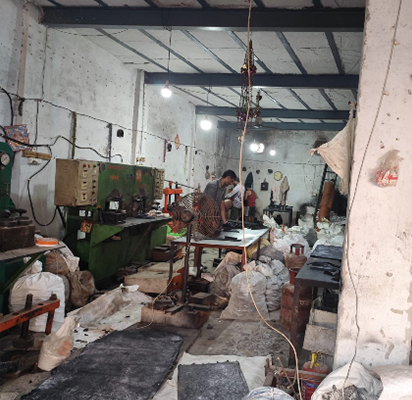
We do not purchase commoditized pre-mixed rubber slabs. Our factory formulates virgin elastomer polymers in-house, custom-tuning Shore A hardness (50 to 75 Shore A), tensile elongation, tear strength, and resilience modulus to customer drawings or specific vehicle chassis loads.
Precision Tooling & Mold Development
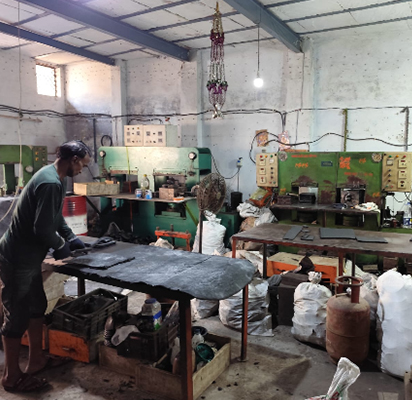
With an extensive archive of tooling dies and progressive stamping presses, we rapidly engineer custom rubber-to-metal parts from physical samples, 2D blueprints, or 3D CAD/STEP models. New tooling commissioning and prototype validation are completed within 21 working days.
Stringent Multi-Axis QA Validation
Every batch of front engine mountings is evaluated for dynamic fatigue resistance on multi-axis pneumatic testing jigs (up to 3,000,000 cycles), bond peel strength (ASTM D429), durometer consistency, and low-temperature cold impact recovery down to -50°C.
Frequently Asked Questions from Russian Buyers & Importers
Direct answers concerning supply agreements, cold climate formulations, customs clearing, and payment terms for Russian logistics operators and parts wholesalers.