Precision Automotive Rubber Components
Engineered for high compression resistance, dynamic mechanical endurance, and fluid resistance under harsh vehicle operating profiles.
Technical Deep-Dive: Elastomer Synthesis & Engineering Disciplines
Modern automotive platforms place rigorous thermo-oxidative and dynamic-mechanical demands on elastomeric components. Standard off-the-shelf rubbers often experience accelerated polymer degradation, premature swelling under synthetic lubricants, or catastrophic micro-cracking caused by cyclic shear strain. In contrast, our manufacturing processes prioritize custom-tailored polymer matrix synthesis aligned with defined operating conditions.
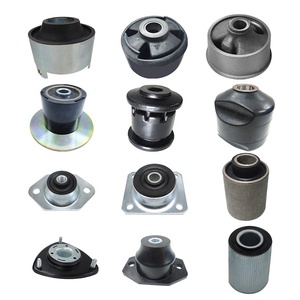
Whether manufacturing engine dampeners, turbocharger hump hoses, suspension bushings, or complex dual-durometer weatherstrips, compound formulations are balanced according to ASTM D2000 specifications. For oil-handling powertrain components, Nitrile Butadiene Rubber (NBR) compounds are balanced for acrylonitrile (ACN) content, mitigating fluid permeation while preventing low-temperature glass transition embrittlement. Where turbocharging temperatures exceed 150°C, we apply Fluoroelastomers (FKM) and peroxide-cured Hydrogenated Nitrile (HNBR) capable of retaining tensile elongation across sustained peak duty cycles.
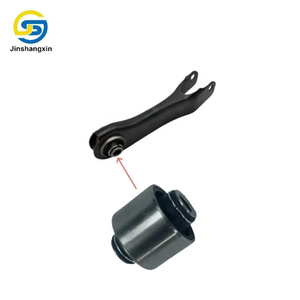
For chassis NVH (Noise, Vibration, and Harshness) dampening, our engineering team formulates anti-crystallizing high-purity natural rubber (NR) and dynamic EPDM blends. These elastomers maintain low loss factors and fatigue thresholds across hundreds of thousands of oscillation cycles, preserving structural bonding integrity at the metal-to-elastomer interface through silane-based chemi-thermal bonding protocols.
Manufacturing Core Competencies & Plant Capabilities
Integrating compounding, precision toolmaking, automated vulcanization, and robotic testing lines.
In-House Tooling & Rheological Lab
In-house CNC machining and EDM wire-cutting ensure mold cavity tolerances within ±0.01mm. Moving Die Rheometers (MDR) evaluate every batch for scorch time, cure rate, and torque limits.
Substrate Chemical Surface Priming
Two-coat automatic spray systems and phosphating cleaning tunnels guarantee exceptional rubber-to-metal vulcanization adhesion, preventing sleeve delamination during dynamic suspension shear.
Liquid Silicone Rubber (LSR) Injection
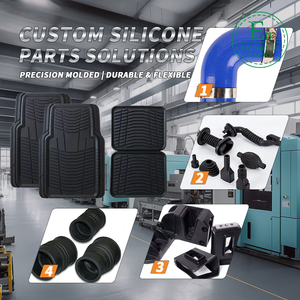
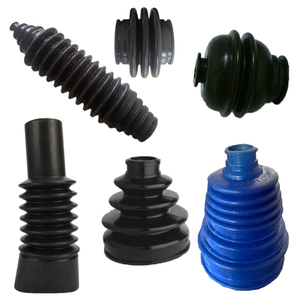
Equipped with closed-loop cold-runner injection molding machines for flashless, micro-tolerance sensor seals, EV battery cooling connectors, and precision boots operating from -60°C to +250°C.
IATF 16949 Quality Traceability
Full APQP, PPAP Level 3 documentation, FMEA analysis, and laser-marked compound batch codes provide supply chain transparency for critical OE programs.
Rapid Prototyping & Mold Flow Analysis
Finite Element Analysis (FEA) and mold-filling simulations reduce design iteration cycles, allowing customized prototypes to ship within 10 to 14 working days.
Consolidated Global Supply Logistics
Leveraging deep industrial partnerships in China's manufacturing clusters alongside direct export logistics, ensuring secure packaging, moisture control, and ocean-ready container staging.
Strategic Procurement Trends: Navigating Modern Automotive Sourcing
The global automotive supply chain is undergoing a structural transformation driven by electrification, emissions targets, and total cost of ownership (TCO) assessments. Tier-1 buyers and regional spare parts distributors are adjusting procurement criteria accordingly:
1. Shift Toward Dual-Polymer Co-Extrusions: New cooling architectures require hoses capable of handling low electrical conductivity fluids without contributing to ionic contamination. Multi-layered hoses combining inner peroxide EPDM cores with aramid knit reinforcements and outer heat-shield elastomers are replacing legacy mono-compound rubber lines.
2. EV Platform Acoustics and Higher Static Loads: Without ICE engine masking noise, high-frequency chassis rattle, road drone, and suspension resonance become noticeable. Bushings now mandate non-linear stiffness profiles, dual-rate damping geometry, and advanced polyurethane-elastomer hybrid matrices engineered for silent operation under heavier electric vehicle curb weights.
3. Supply Consolidation via Direct-from-Factory Turnkey Programs: Procurement executives are transitioning away from intermediary traders to establish integrated manufacturing partnerships. Direct-to-factory collaborations minimize miscommunication around dimensional tolerances, reduce tooling amortizations, and accelerate root-cause resolution via 8D defect containment.
Elastomer Engineering & Technological Evolution
The transition toward higher vehicle efficiencies and alternative fuel chemistries drives ongoing evolution in polymer formulations:
Advanced Fluorosilicone (FVMQ) Integration: As turbocharged engines operate at higher boost pressures and blow-by gas temperatures, conventional silicone fails to resist hydrocarbon permeation. High-tear FVMQ matrices bridge the gap by combining silicone's thermal stability (-60°C to +200°C) with fluorocarbon resistance to synthetic oils and aggressive fuels.
Bio-Sourced and Devulcanized Closed-Loop Feedstocks: Automotive sustainability directives demand measurable CO2 lifecycle reductions. Next-generation compounds are incorporating devulcanized reclaimed rubber without compromising elongation or tensile durability, assisting automotive brands in meeting Scope 3 decarbonization benchmarks.
Automated Optical Inspection (AOI) Sorting: Zero-PPM defect targets have elevated quality control standards across Tier-1 supply lines. High-speed 360-degree glass plate optical sorting machines measure seal outer/inner diameters and detect flash, voids, or inclusions down to 20 microns, eliminating manual sorting oversights.
Procurement & Engineering FAQ
Straightforward technical answers to common questions from Tier-1 buyers, system assemblers, and aftermarket distributors.
How do you verify dynamic rubber-to-metal bonding adhesion?
We test adhesion integrity following ASTM D429 (Method B: 90-degree peel test). Substrates are shot-blasted, degreased, and treated with two-coat silane bonding adhesives. Failures must occur within the rubber matrix itself (100% rubber cohesive failure), confirming that the bond exceeds the structural tensile strength of the elastomer.
What documentation is provided with first article inspections (FAI)?
For custom automotive programs, we provide a complete PPAP Level 3 package. This includes raw material certificate of analysis (COA), IMDS submission records, full dimensional CMM balloon drawings, Control Plan, PFMEA, Gage R&R studies, and rheometer cure curve data sheets.
How do you address compression set and oil aging for powertrain seals?
Compression set is evaluated under ASTM D395 (Method B) at 125°C or 150°C for 22 to 70 hours. Our compounding engineers tailor the cross-linking structure using efficient vulcanization (EV) or peroxide-cure systems, keeping compression set under 20% to prevent fluid bypass across extended service intervals.
What are standard lead times for custom tooling and initial sampling?
Standard prototype mold tooling typically takes 12 to 18 working days depending on core complexity. Once molds are installed, initial samples are cured, stabilized, and evaluated via optical vision systems before dispatching to client facilities with complete dimensional inspection reports.
Connect with Our Automotive Polymer Engineering Team
Submit 2D/3D component drawings (STEP, IGES, DWG) along with target elastomer specifications (Shore A hardness, working media, continuous temperature range) for a comprehensive DFM evaluation and quote.
Send an Inquiry